
Not Your Average Household Dust
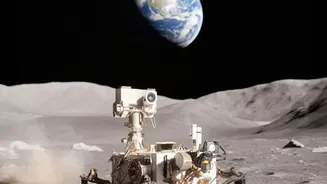
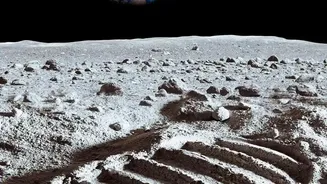
To understand the danger, you first have to appreciate that lunar dust, or regolith, is unlike anything on Earth. For billions of years, the Moon's surface has been bombarded by micrometeorites without an atmosphere or water to smooth the resulting particles
down. The result is a fine powder composed of tiny, jagged shards of glass and minerals. These particles are not only as sharp as microscopic glass, but they are also electrostatically charged by solar radiation. This charge makes the dust incredibly sticky, causing it to cling to any surface it touches, from spacesuits and camera lenses to scientific equipment. Apollo astronauts discovered just how persistent it was; they tried to brush it off their suits, only to find the abrasive material wore down their tools and clung even tighter.
The Hazard Inside: Health Risks
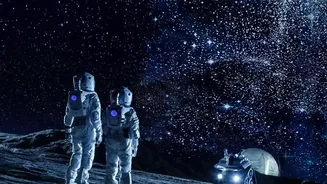
The first line of risk is to the astronauts themselves. During the Apollo missions, crew members brought a significant amount of dust back into their cramped lunar module. Once inside, the fine particles became airborne, leading to what astronaut Harrison Schmitt called 'lunar hay fever'. Astronauts reported sneezing, watery eyes, and sore throats. While these symptoms were temporary, scientists are deeply concerned about the effects of long-term exposure, which is inevitable in a permanent habitat. Studies using lunar dust simulants on human lung cells have shown alarming results, with some research indicating that the dust can kill cells and cause significant DNA damage. The fear is that chronic exposure could lead to serious respiratory conditions like bronchitis or even increase the risk of cancer, as the fine, sharp particles can lodge themselves deep within lung tissue.
The Hazard Outside: Equipment Failure
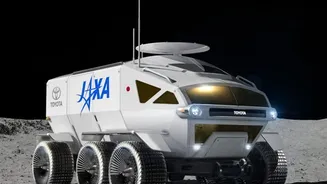
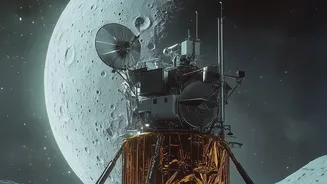
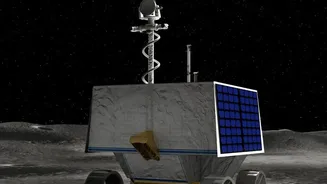
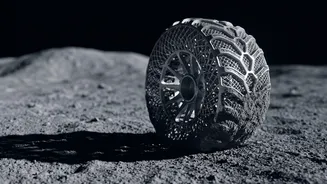
Outside the habitat, lunar dust poses an existential threat to the technology that keeps astronauts alive. Its abrasive nature is like a relentless sandpaper. During the Apollo era, it wore through layers of spacesuit boots, scratched helmet visors, and caused vacuum seals on sample containers to fail. For future long-term missions, the risks are magnified. Dust can coat solar panels, drastically reducing their ability to generate power. It can settle on thermal radiators, causing critical systems to overheat. The microscopic particles can work their way into mechanical joints, gears, and seals, causing them to clog and fail. Even landing a spacecraft is a hazard, as the rocket exhaust can blast this abrasive grit at high velocity, potentially shredding any nearby equipment or structures.
The Search for a Solution
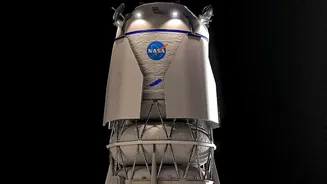
Solving the dust problem is a top priority for space agencies like NASA as they plan for a sustainable presence on the Moon with the Artemis program. The strategy is multi-pronged, involving both prevention and active removal. New habitats will likely feature a dedicated airlock, a 'mudroom' where astronauts can clean their suits and equipment before entering the main living quarters. But brushing is not enough. Researchers are developing advanced technologies to fight back. One of the most promising is the Electrodynamic Dust Shield (EDS). This system uses a network of transparent electrodes to create an electric field that actively repels dust particles from surfaces. It's flexible enough to be woven into spacesuit fabrics or applied as a transparent layer on solar panels and camera lenses. Other concepts include using electron beams to charge the dust particles, causing them to repel each other and fly off surfaces.