





The Cosmic Detective's New Case
The James Webb Space Telescope (JWST) was built to answer big questions about the universe, but sometimes its most exciting discoveries come from the questions it creates. Recently, astronomers aimed the telescope's powerful infrared eye at a nearby white
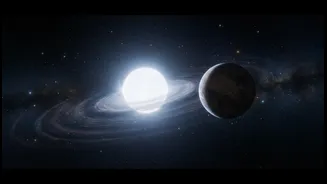
dwarf, the collapsed remnant of a star much like our own sun. Instead of a quiet, predictable stellar corpse, they found a crime scene. The latest observations, published in early July 2026, revealed the presence of unexpected molecules in the atmosphere of a gas giant planet orbiting a dead star. Specifically, Webb detected methane and hazes around the planet WD 1856 b, which orbits its tiny, dead star at an impossibly close distance. This discovery has thrown astronomers into what the headline playfully calls 'mystery mode', as they scramble to explain how this planet is not only present but has an active-looking atmosphere.
What is a White Dwarf?
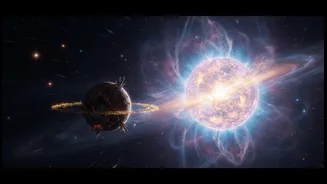
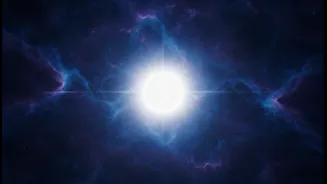
Before we dive into the mystery, let's get to know the subject: the white dwarf. Think of it as a star's ghost. When a star up to about eight times the mass of our sun runs out of fuel, it can't support its own weight anymore. It sheds its outer layers into space, forming a beautiful planetary nebula. What's left behind is its incredibly dense, hot core. This core, no longer producing energy through fusion, is a white dwarf. It's an object with the mass of the Sun packed into a sphere the size of the Earth. Over billions of years, it simply cools down, like a dying ember in the cosmic fireplace. Our own sun will become a white dwarf in about five billion years, making these stellar remnants a preview of our solar system's distant future.
A Planet That Shouldn't Exist
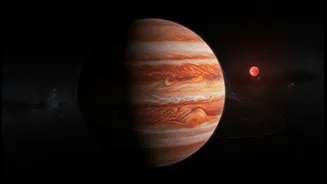
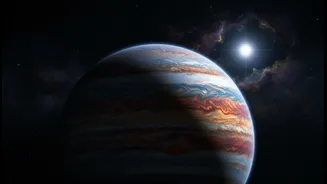
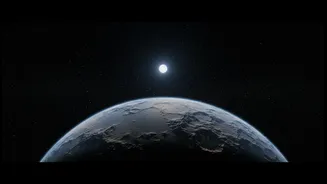
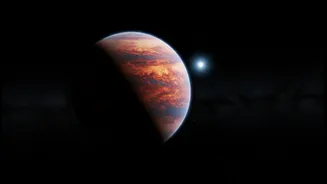
The planet at the heart of the mystery, WD 1856 b, is a true survivor. It's a gas giant, similar in size to Jupiter, but it orbits its white dwarf once every 34 hours. This orbit is fifty times closer than Earth's orbit around the Sun. Here's the puzzle: when the original star expanded into a red giant, it should have completely engulfed and destroyed any planet that close. The fact that WD 1856 b is still there is a major contradiction. Finding it was already a surprise when it was discovered in 2020. Now, Webb's data deepens the enigma. Not only did the planet survive, but it has a complex atmosphere and is much warmer than it should be, heated only by the faint light of its dead star.
The Hunt for an Explanation
So, how did this planet get there? Webb's new data points to a dramatic history of migration. The leading theory is that the planet, WD 1856 b, started its life on a much wider, safer orbit. It survived the star's violent red giant phase from a distance. Then, over billions of years, gravitational nudges, perhaps from two other stars in the same system, pushed the planet onto a new, inward-spiraling path. As it moved closer to the incredibly dense white dwarf, the immense gravity of the star would have squeezed and flexed the planet, a process called tidal heating. This process would have generated enormous amounts of internal heat. The warmth Webb detects today is likely the leftover energy from that chaotic journey, slowly radiating away into space billions of years later. The methane in its atmosphere is a key chemical signature of this strange, post-death planetary system.
Why This Cosmic Mystery Matters
This discovery is more than just a strange cosmic quirk; it's the birth of a new kind of forensics. Some astronomers call it 'necroplanetology'—the study of what happens to planets and their solar systems after their stars die. Webb's ability to analyse the faint light passing through the atmosphere of a planet orbiting a dead star is a technological marvel. It gives us a fascinating, and slightly unnerving, glimpse into our own solar system's ultimate fate. While Mercury, Venus, and Earth will likely be destroyed when our sun becomes a red giant, this research suggests that Jupiter and Saturn might survive and could even be nudged into new, strange orbits around the Sun's white dwarf remnant. It shows that even after a star's death, its planetary system can have a vibrant, dynamic, and mysterious second act.