






A Tale of Two Rotations
To understand the tachocline, you first need to appreciate that the Sun doesn't spin like a solid ball. The star is a giant sphere of plasma (superheated gas). Its outer third, the convection zone, rotates differentially: the equator spins fastest, completing
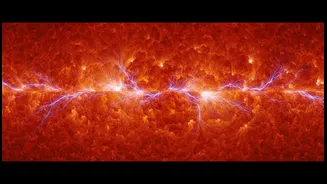
a rotation in about 25 days, while the poles lag, taking around 36 days. Beneath this churning layer, however, lies the radiative zone, which rotates rigidly, as if it were a solid body. The tachocline is the incredibly thin, turbulent interface separating these two distinct rotational zones. First proposed in 1992, its existence was confirmed by helioseismology, the study of pressure waves rippling through the solar interior.
The Great Shear Layer
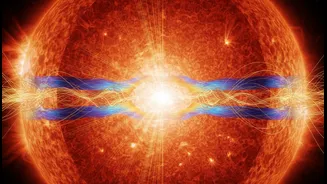
The tachocline is located about 200,000 kilometres below the Sun's surface, yet it's only about 30,000 kilometres thick—remarkably thin relative to the Sun's total radius. What makes this layer so crucial is the immense shear created there. Imagine two adjacent parts of a fluid moving at drastically different speeds and in different ways. This is what happens in the tachocline, where the uniform rotation of the deep interior grinds against the chaotic, differential rotation of the convection zone above. This violent shearing of conductive plasma is the perfect environment for generating and amplifying magnetic fields.
The Engine of the Solar Dynamo
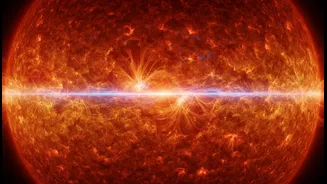
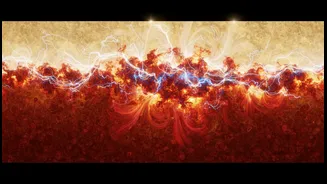
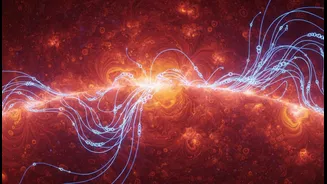
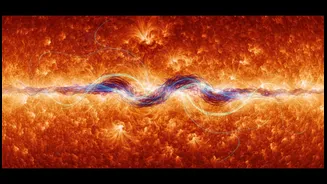
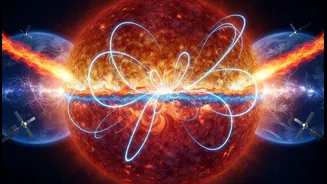
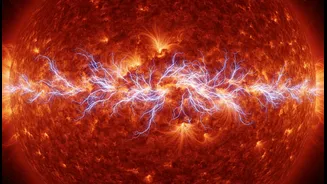
Scientists believe the tachocline is the primary seat of the solar dynamo, the process that generates the Sun's massive magnetic field. The dynamo theory posits that the movement of an electrically conductive fluid can generate and sustain a magnetic field. In the tachocline, the shear takes weak, north-south oriented (poloidal) magnetic field lines and stretches them, wrapping them around the Sun like elastic bands. This process dramatically strengthens them, creating powerful, east-west oriented (toroidal) magnetic fields. These toroidal fields become the raw material for the sunspots and solar flares we observe on the surface.
Driving the 11-Year Solar Cycle
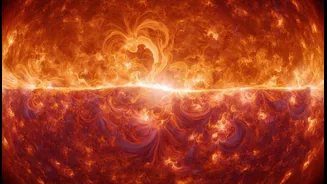
The tachocline's role as a magnetic factory is fundamental to the Sun's 11-year activity cycle. The powerful toroidal magnetic fields generated in this layer eventually become unstable. They form buoyant loops of magnetism that rise through the 200,000 kilometres of the convection zone. When these loops burst through the photosphere, the Sun's visible surface, they create pairs of sunspots. These sunspots are cooler, darker areas where magnetic activity is intensely concentrated. The entire process—from the stretching of field lines in the tachocline to the emergence of sunspots—drives the cyclical rise and fall of solar activity, including solar flares and coronal mass ejections (CMEs).
Why It Matters on Earth
The processes occurring deep within the Sun's tachocline have tangible consequences for us, 150 million kilometres away. The magnetic activity born in this layer is the source of space weather. Powerful events like solar flares and CMEs can hurl vast amounts of charged particles and radiation into space. If aimed at Earth, these solar storms can have significant impacts. They can disrupt and damage satellites, which are crucial for GPS, communications, and weather forecasting. They can also interfere with high-frequency radio communications and even induce powerful currents in power grids on the ground, potentially causing widespread blackouts. Understanding the tachocline is therefore key to better predicting space weather and protecting our increasingly technology-dependent society.