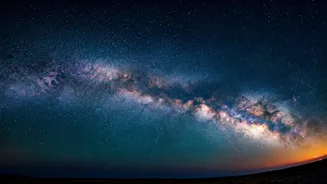




Our Sky, a Living Museum
We often talk about the speed of light as an impossibly fast constant, but over the vast distances of space, even light takes time. A lot of time. This simple fact transforms the night sky from a static backdrop into a dynamic, living museum. Every star
you see is a window into the past. The light hitting your retina tonight did not begin its journey a moment ago; it started years, decades, or even hundreds of years in the past. The unit astronomers use to measure this is the 'light-year'—the distance light travels in one year, which is roughly 9.5 trillion kilometres. So, when we say a star is 100 light-years away, we mean the light we see from it tonight left that star 100 years ago. You are, quite literally, looking at history.
Greetings from the Recent Past
Let’s start with a familiar neighbour. One of the brightest stars in our night sky is Sirius, also known as the 'Dog Star'. It’s relatively close to us, at about 8.6 light-years away. This means the light from Sirius that you see tonight began its journey around 8-9 years ago. Think about what you were doing back then. Perhaps you were starting a new job, finishing school, or watching India lift the 2013 ICC Champions Trophy. While those memories were being made on Earth, the photons of light from Sirius were already hurtling through space on their way to your eyes. Looking at Sirius isn't just seeing a star; it's receiving a postcard from the very recent past.
A Message from Another Generation
Now, let’s look a bit further. Vega, another brilliant star visible in the Northern Hemisphere, is about 25 light-years away. The light we see from Vega tonight left the star around the late 1990s. This was the era of dial-up internet, the rise of Bollywood's 'Khans', and India’s victory in the Kargil War. For anyone born after that time, the light from Vega is older than they are. When you point out Vega to a child, you can tell them that the light they are seeing is from a time before they even existed. It’s a humbling perspective that connects generations across a cosmic scale, reminding us that the universe operates on timelines far grander than our own.
Echoes from a Bygone Empire
The truly mind-bending experience comes when we gaze at stars that are hundreds of light-years away. Consider Betelgeuse, the fiery red giant in the constellation of Orion. It’s approximately 640 light-years from Earth. The light we see from it tonight started its journey around the year 1380. At that time in India, the Tughlaq dynasty was ruling the Delhi Sultanate. The Vijayanagara Empire was flourishing in the south. The concept of India as a single nation-state was centuries away. The light from Betelgeuse has been travelling through space during the entire rise and fall of the Mughal Empire, the whole of the British Raj, and all of India's journey as an independent nation. When you look at that single point of light, you are witnessing an echo from a completely different historical epoch.
How to Be a Starlight Time Traveller
You don’t need a fancy telescope to appreciate this cosmic time-travel. You just need a clear night and a little patience. Find a spot away from bright city lights, which cause light pollution and wash out fainter stars. Let your eyes adjust to the darkness for about 15-20 minutes; you'll be amazed at how many more stars become visible. You can use a simple stargazing app on your phone to identify bright stars like Sirius, Vega, or the ones in Orion. Knowing their names is fun, but knowing their history is profound. Each star becomes a story, a message from a different point in time, all arriving in your present moment.