




A New Cosmic Surveyor
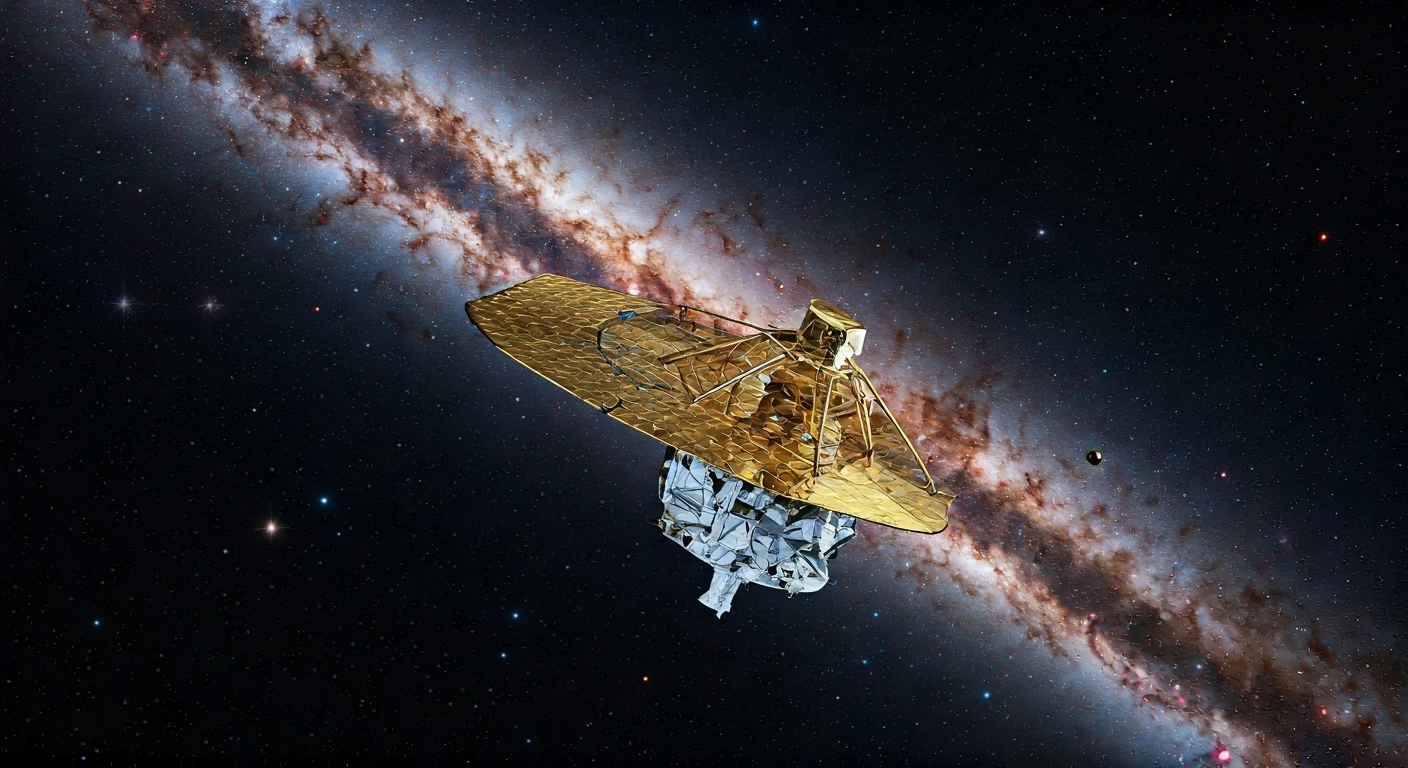
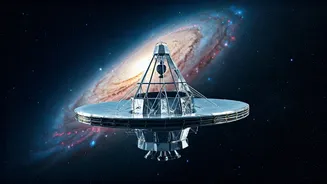
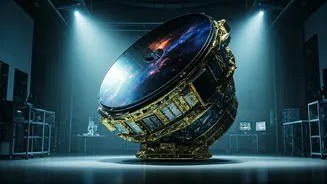
Named after NASA's first chief of astronomy, Nancy Grace Roman, this next-generation telescope is designed to unravel mysteries surrounding dark energy, exoplanets, and infrared astrophysics. While it has a primary mirror the same size as the Hubble Space
Telescope's—2.4 meters (7.9 feet)—its power lies in its incredible efficiency. The telescope recently arrived at Kennedy Space Center in Florida, beginning its final preparations for a launch aboard a SpaceX Falcon Heavy rocket. The mission, which was recommended as a top priority by the National Research Council in 2010, will travel to the second Sun-Earth Lagrange point (L2), a stable gravitational point about 1.5 million kilometers from Earth.
The Power of a Panoramic View
Roman's key advantage is its Wide Field Instrument (WFI), a 300.8-megapixel camera that gives it a field of view at least 100 times larger than Hubble's infrared instrument. This vast panorama means Roman can map huge swathes of the sky with incredible speed and detail. To put it in perspective, a single image from Roman will contain the equivalent detail of 100 pictures from Hubble. This capability will enable astronomers to conduct massive surveys, measuring light from a billion galaxies and capturing data on a scale previously unimaginable. This 'big picture' approach is what makes Roman a powerful survey telescope, complementing the deep, narrow views of observatories like Hubble and the James Webb Space Telescope (JWST).
Chasing the Ghost: The Hunt for Dark Energy
One of Roman's primary missions is to confront one of the greatest puzzles in physics: dark energy. This mysterious force is believed to make up about 68% of the universe and is responsible for its accelerating expansion. Roman will investigate dark energy using three distinct methods: observing distant Type Ia supernovae (which act as cosmic distance markers), mapping the large-scale structure of the universe through Baryon Acoustic Oscillations (BAOs), and studying how the light from distant galaxies is distorted by the gravity of intervening matter, a phenomenon called weak gravitational lensing. By combining these techniques, scientists hope to determine if cosmic acceleration is caused by a new energy component or a breakdown of Einstein's theory of general relativity on cosmic scales.
A Census of a Billion Worlds
Roman is also set to be a prolific planet hunter. While missions like Kepler and TESS have found thousands of planets, they primarily use the transit method, which is best at finding large planets orbiting very close to their stars. Roman will employ a powerful technique called gravitational microlensing. This method occurs when a star or planet passes in front of a more distant star, causing the foreground object's gravity to act like a lens, briefly magnifying the background star's light. This technique is sensitive enough to find planets with masses as low as a tenth of Earth's, including worlds farther from their stars and even 'rogue' planets that drift through space untethered to a star. Scientists anticipate that Roman will find thousands of exoplanets, creating a broad census of planetary systems throughout our galaxy.
Seeing Planets Directly
In addition to its wide-field surveys, Roman will test a groundbreaking technology called a coronagraph. This instrument is designed to block the overwhelming glare from a star, allowing the telescope to directly image the much fainter planets orbiting it. This is incredibly difficult, akin to spotting a firefly next to a powerful spotlight. The Coronagraph Instrument (CGI) will serve as a technology demonstrator, paving the way for future missions like the Habitable Worlds Observatory. It will aim to capture the first direct images and spectra of giant planets around nearby stars, allowing scientists to analyze their atmospheric composition.