



The Old Guard of Automation
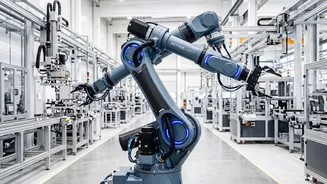
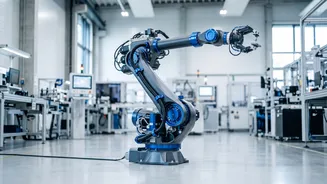
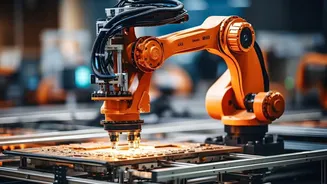
Traditional industrial robots are masters of repetition. Programmed with a fixed set of motions, they excel in highly structured environments where their task never changes. Think of a car factory, where a robot welds the same spot on every car door that
passes. While incredibly efficient for mass production, these machines lack any real intelligence or adaptability. If a part is slightly out of place, if a new object is introduced, or if the task changes, the robot either fails or requires extensive human reprogramming. This limitation has kept automation confined to predictable, high-volume tasks, leaving a vast world of complex, variable physical work exclusively in the hands of humans. The 'fixed motion' paradigm has been a powerful workhorse for industry, but its inability to handle unpredictability has always been its Achilles' heel.
Giving Robots a Sense of Touch
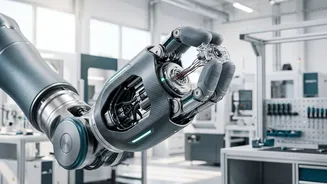
Enter Eka Robotics, a US-based startup that is pioneering a fundamental shift in how robots interact with the world. The company's core innovation is a sophisticated AI model it calls 'Vision-Force-Action' (VFA). While many modern robots use computer vision to 'see' and identify objects, Eka's system adds a crucial third sense: touch, or more accurately, force feedback. This allows the robot to not only see where an object is but also feel it. It can sense if a grip is slipping and adjust its hold, or use the physical contact with a surface to better locate and handle an item. By integrating force as a primary source of information, Eka is aiming to solve one of the most stubborn problems in robotics: dexterous manipulation in unstructured environments. This is the difference between a robot that can only follow a visual path and one that can feel its way through a complex task, much like a person would.
Learning at Digital Speed
Instead of being programmed line-by-line or learning by mimicking human actions, Eka's robots learn through experience—at a scale impossible in the real world. The company uses advanced physics simulators where a digital version of the robot can practice a task millions of times in a virtual environment. This process, known as reinforcement learning, allows the AI to learn through trial and error, getting progressively better by maximising rewards for correct actions. Eka can generate thousands of hours of robotic experience in just a few minutes, varying the objects, environments, and physical conditions each time. The 'intelligence' developed in this simulated world is then transferred to the physical robots. This 'sim-to-real' approach overcomes the bottleneck of real-world data collection and enables the robots to generalise their skills to objects and situations they have never encountered before, achieving both high performance and adaptability.
Superhuman Speed and Dexterity
The results of this new approach are staggering. In laboratory tests, Eka's robots have demonstrated the ability to pick and place objects at a rate of 1,500 items per hour—more than double the average human speed of around 600 items per hour. Moreover, they can achieve this with over 95% accuracy while handling a wide variety of items, from slippery industrial parts to fragile objects, without being retrained for each one. The same system has been shown to perform contact-rich tasks like screwing in a lightbulb or inserting wires, actions that are notoriously difficult for traditional robots. This breakthrough performance has caught the attention of the tech industry, leading to a recent $150 million funding round led by major venture capital firms, signalling strong confidence in Eka's potential to redefine industrial and logistical automation.
From the Lab to the Factory Floor
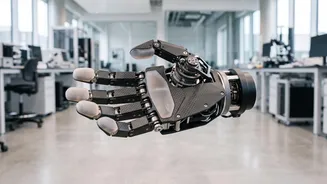
Despite the impressive lab results, the true test for Eka Robotics lies ahead. The company must prove that its technology can operate reliably for thousands of hours in the chaotic and demanding environments of real-world factories and warehouses. Sustaining performance through full production shifts is a significant hurdle that separates a lab demo from a commercial product. Furthermore, the durability of the hardware itself, including the specialised robotic gripper, will need to meet stringent industrial standards to gain widespread adoption. The company is currently running pilots with industrial partners to test its systems in pick-and-place and wire-handling tasks, which will be crucial in proving the real-world viability and scalability of its VFA model.