





The Challenge of Seeing a Speeding Bullet
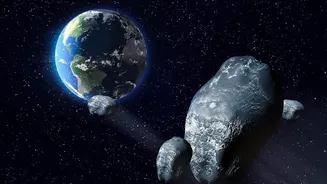
Imaging an asteroid from Earth presents immense challenges. These objects are often small, dark, and moving at incredible speeds. The vast distances involved mean that even large ground-based telescopes see them as little more than pinpricks of light.
To make matters worse, Earth's turbulent atmosphere blurs and distorts this already faint light, an effect we see as the twinkling of stars. Overcoming this atmospheric distortion is the first and most critical hurdle to getting a clear view.
Adaptive Optics: Taming the Twinkle
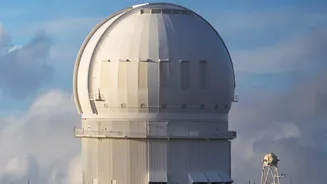
To counteract atmospheric blur, astronomers use a remarkable technology called adaptive optics (AO). An AO system works by using a flexible, 'deformable' mirror in the telescope's light path. A sensor measures the incoming light's distortion in real-time by observing a nearby bright star or by creating an artificial 'guide star' with a powerful laser. A computer then calculates the precise adjustments needed, and tiny actuators push and pull on the deformable mirror up to a thousand times per second, bending it to cancel out the atmospheric distortion. This process smooths the jumbled light, allowing the telescope’s camera to capture a much sharper image, almost as if it were in space.
Radar Astronomy: Seeing with Radio Waves
While adaptive optics sharpens visible light, another powerful technique, radar astronomy, doesn't rely on light at all. Instead, a large radio telescope, like those at NASA's Goldstone Deep Space Network, acts like a giant flashlight, beaming a powerful radio signal toward the asteroid. This signal bounces off the asteroid's surface, and the faint echo is collected by the same telescope or another one. Because this is an active process—scientists control the outgoing signal—they can learn much more than from passive observation. By analyzing the echo's timing and frequency changes (Doppler shift), scientists can construct detailed 3D models of the asteroid.
Delay-Doppler: Building a 3D Picture
The magic of radar imaging lies in a method called delay-Doppler mapping. The 'delay' refers to the time it takes for the radio signal to return, which reveals the distance to different parts of the asteroid. Reflections from the nearest point arrive first, followed by echoes from the edges and the far side. The 'Doppler' refers to the shift in the radio frequency caused by the asteroid's rotation. Parts spinning toward Earth compress the radio waves (shifting them to a higher frequency), while parts spinning away stretch them. By combining delay and Doppler data, scientists can create a detailed 3D shape model, revealing craters, boulders, and even the object's precise spin. This method can produce images with resolutions as fine as a few meters.
The Digital Eyes: Advanced CCD and CMOS Sensors
Whether it's corrected light from an adaptive optics system or the faint signal from a radio echo, the data must be captured. This is the job of highly advanced imaging sensors, typically Charge-Coupled Devices (CCDs) or Complementary Metal-Oxide-Semiconductor (CMOS) sensors. These are essentially digital eyes, grids of millions of light-sensitive pixels. For astronomy, these sensors are designed for extreme sensitivity, capable of detecting the faintest photons. Modern back-illuminated CMOS sensors offer high quantum efficiency (capturing over 90% of incoming light), low noise, and high speeds, making them ideal for capturing dynamic astronomical events. Many are cooled to temperatures as low as -100°C to minimize thermal noise during long exposures.
Why It Matters: From Science to Safety
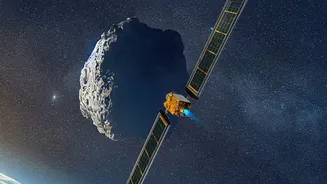
Mapping asteroids isn't just an academic exercise. High-resolution data is crucial for planetary defense. By precisely determining an asteroid's size, shape, and orbit, scientists at NASA's Planetary Defense Coordination Office can more accurately predict if it poses an impact threat to Earth. This information was vital for missions like DART (Double Asteroid Redirection Test), which tested our ability to deflect a hazardous asteroid. Furthermore, understanding an asteroid's surface and composition provides invaluable clues about the formation of our solar system billions of years ago.