



The Cosmic Commute
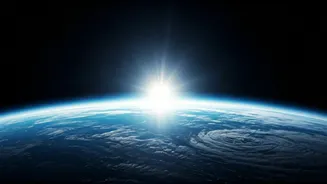
The statement in the headline isn’t poetry; it’s physics. The Sun, our life-giving star, is on average about 150 million kilometres away from Earth. Light, though the fastest thing in the universe, still has to cover this immense distance. It travels
at a staggering speed of approximately 2,99,792 kilometres per second. When you do the maths (Distance ÷ Speed), it comes out to roughly 500 seconds. Convert that to minutes, and you get the magic number: eight minutes and twenty seconds. So, every time you feel the sun on your skin, you’re experiencing energy that left the Sun while you were still in the past.
A Universal Speed Limit
The speed of light, often denoted by the letter 'c', is the ultimate speed limit in the universe. Nothing with mass can reach it, and nothing at all can surpass it. To put its speed into perspective, a photon of light could circle the Earth’s equator more than seven times in a single second. It’s this incredible velocity that allows light from the Sun to reach us in what seems like a relatively short time, despite the astronomical distance. This constant speed is a fundamental pillar of modern physics, underpinning Einstein’s theory of relativity and shaping our entire understanding of space and time.
You Are Always Looking Back In Time
Here is where things get truly mind-bending. Because light takes time to travel, whenever we look at something, we are seeing it as it was in the past. For the cup of chai on your desk, the time delay is a meaningless fraction of a nanosecond. But for the Sun, it’s significant. The Sun you see in the sky is the Sun as it was eight minutes and twenty seconds ago. This effect is a form of time travel, built into the very fabric of our universe. We are never truly seeing the present moment of anything in the cosmos; we are only seeing the old light that has finally reached our eyes.
What If The Sun Disappeared?
This leads to a famous thought experiment. If the Sun were to suddenly and magically vanish, what would happen on Earth? For eight minutes and twenty seconds, absolutely nothing. We would continue to see the Sun in the sky, feel its warmth, and orbit it as if everything were normal. The sky would remain bright. Only after that time delay had passed would darkness fall and the Earth, no longer held by the Sun’s gravity, fly off into space in a straight line. It's a dramatic illustration that we are tethered to our star by forces and light that are not instantaneous, but messengers travelling across the void.
Beyond Our Solar System
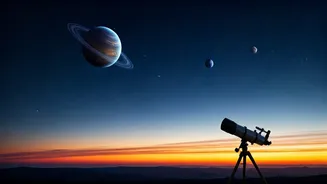
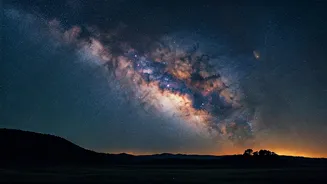
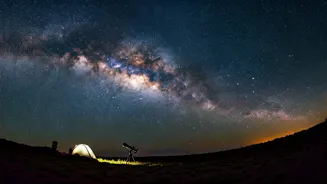
This principle scales up dramatically as we look further into space. The next nearest star, Proxima Centauri, is about 4.2 light-years away. That means the light we see from it tonight left that star 4.2 years ago. When you look at the bright star Sirius, often visible in the Indian night sky, you are seeing light that is over eight and a half years old. The stars in the beloved Orion constellation are hundreds or even thousands of light-years away. The Andromeda Galaxy, the most distant object visible to the naked eye, is 2.5 million light-years away. The light hitting your retina from Andromeda began its journey when early human ancestors were first walking the Earth. The night sky is not a snapshot; it's a gallery of ancient history.