



Taming the Cosmic Data Flood
Every single day, ISRO's constellation of Earth observation, communication, and scientific satellites beams down terabytes of complex data. This includes high-resolution images, atmospheric readings, and telemetry from distant spacecraft. Manually sifting
through this digital mountain to find specific, actionable insights—like the early signs of a cyclone, illegal mining activity, or a tiny anomaly in a satellite's health report—is a monumental task. Artificial intelligence algorithms can automate this process with incredible speed and accuracy. Machine learning models can be trained to instantly spot patterns that a human eye might miss, filter out irrelevant images (like those covered by clouds), and flag critical events for immediate attention, turning a flood of raw data into life-saving, resource-managing intelligence.
Smarter Navigation for Deep Space
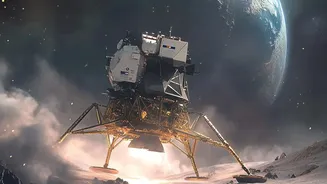
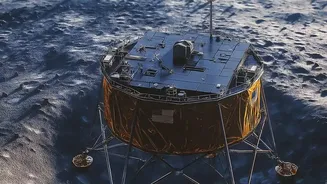
When a spacecraft is millions of kilometres away, communication isn't instant. The signal delay to Mars, for instance, can be over 20 minutes each way. This makes real-time control impossible. Future missions to Venus or even more distant asteroids will require spacecraft to think for themselves. AI-powered autonomous navigation is the solution. Much like NASA's Perseverance rover uses AI to analyse Martian terrain and plot its own safe path, ISRO's future probes could use similar tech to dodge space debris, identify the most scientifically promising landing sites, and make crucial course corrections without waiting for commands from Earth. This capability was already demonstrated in part during the Chandrayaan-3 mission, where AI-assisted systems helped the lander analyse the lunar surface for a safe touchdown.
An AI Co-Pilot for Gaganyaan
India's landmark human spaceflight mission, Gaganyaan, presents a new level of complexity: keeping astronauts safe. AI is set to play a crucial role here. For the initial uncrewed test flights, ISRO is deploying 'Vyommitra', an AI-enabled humanoid robot designed to mimic crew activities and monitor cabin parameters like temperature and pressure. In future crewed missions, AI will serve as a tireless co-pilot. It can continuously monitor astronaut health vitals, watch over the spacecraft’s life support systems, and run predictive diagnostics to flag potential equipment failures before they become critical. This frees up the human crew to focus on mission objectives, safe in the knowledge that an intelligent system is keeping a constant watch.
Designing Better, Faster Missions
Long before a rocket ever reaches the launchpad, its mission undergoes thousands of hours of design and simulation. AI can drastically accelerate this process. Using techniques like generative design, engineers can input their goals and constraints—such as weight, materials, and desired trajectory—and an AI can generate and test thousands of potential designs in a fraction of the time it would take humans. This allows for the creation of more efficient, lightweight components and highly optimized flight paths that save precious fuel. AI is also being developed to improve space traffic management, helping to predict the orbits of satellites and debris to ensure safe and collision-free operations for India's growing assets in space.