








The Viral Border
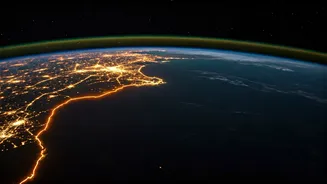
It’s a story that resurfaces every few months, captivating social media in India and beyond. A photograph, often attributed to NASA or an astronaut on the ISS, shows a stark, brilliantly lit line. This, the captions declare, is the heavily floodlit border
between India and Pakistan—one of the few man-made structures visible from space at night. The image is frequently shared with a mixture of awe and national pride. Recently, a video captured by an IndiGo pilot from his cockpit showed a similar view, reigniting the viral phenomenon and sending it across Instagram and X (formerly Twitter). The reactions are often passionate, ranging from wonder at the scale of the fortification to somber reflections on the division it represents.
A Tale of Two Photos
The “crazy ISS fact” at the heart of this isn't just one fact, but a blend of truth and exaggeration built around several real images. The most famous photographs were indeed taken from the International Space Station. One widely circulated image was taken by a member of the Expedition 45 crew on September 23, 2015. NASA itself has published these photos, noting that the winding orange line is indeed the India-Pakistan border, illuminated by security floodlights. Another popular image dates back to 2011, taken by astronaut Ron Garan. So, yes, the core claim is true: the border is so extensively lit that it is visible from space and has been photographed by astronauts. It stands out as a unique and vivid testament to the geopolitical realities on the ground.
What the Internet Gets Wrong
The “split” on the Indian internet happens when reality meets viral hyperbole. While the images are real, the context is often lost. Many posts imply the photo is a live feed or was taken “last night,” when in reality the most famous images are over a decade old. The internet debate is less about the fact itself and more about its presentation. One side shares the image with swelling pride, a symbol of national strength and vigilance. The other side quickly swoops in to debunk the immediacy of the post, pointing out that it's an old photo. This leads to arguments about authenticity, nationalism, and the tendency for such images to become digital artifacts of the long-standing political tension between the two nations. Astronaut Ron Garan, who took the 2011 photo, reflected on this, calling the sight “sobering” and a “man-made” response to a threat, a stark contrast to the usually peaceful view of Earth from space.
Why We Can't Look Away
Why does this image have such a hold on the Indian public consciousness? The answer lies in its powerful symbolism. The Radcliffe Line, established during Partition in 1947, is more than a line on a map; it's a scar of history. Seeing it etched in light from an orbital perspective is a powerful and jarring experience. For some, the 2,000 to 3,000 kilometers of floodlit border represents security and a well-defended frontier. For others, it’s a constant, multi-billion rupee reminder of a persistent conflict. The image from space removes all the noise and complexity of the on-ground situation and reduces it to a single, easily digestible, and highly emotional visual. It's a perfect piece of content for the age of social media: visually stunning, emotionally resonant, and endlessly debatable. This potent combination ensures that, for years to come, the view of the border from the ISS will continue to light up our screens and divide opinions.