





The Sun’s Fiery Threat
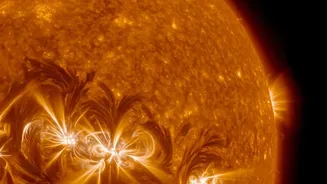
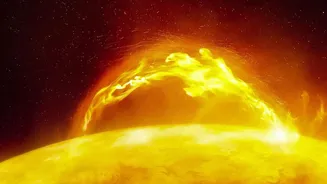
The sun, while the source of all life on Earth, is also a volatile star. It regularly ejects massive bursts of energy and particles. The two main events that threaten satellites are solar flares and coronal mass ejections (CMEs). A solar flare is an intense
blast of radiation, primarily X-rays and extreme ultraviolet light, which travels at the speed of light and reaches Earth in about eight minutes. A CME is a much larger eruption, sending a cloud of magnetised plasma and charged particles hurtling through space. This cloud travels slower, taking one to three days to reach Earth. When these high-energy particles strike a satellite, they can cause significant damage. They can penetrate the craft's shielding and short-circuit electronics, generate phantom commands that cause the satellite to behave erratically, or degrade solar panels, reducing the satellite's lifespan. This is known as a single-event effect, where one particle can flip a memory bit or even cause permanent burnout of a component.
Our Eyes on the Sun
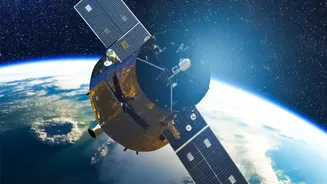
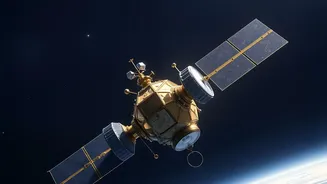
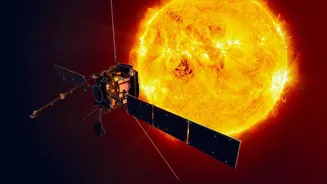
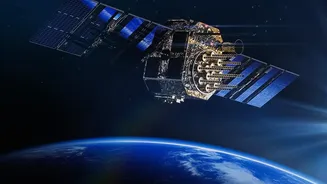
To guard against this threat, a network of satellites acts as a dedicated early-warning system. These robotic sentinels are strategically placed to keep a constant watch on the sun. The Geostationary Operational Environmental Satellites (GOES) fleet, operated by America's National Oceanic and Atmospheric Administration (NOAA), is a cornerstone of this system. While known for tracking weather on Earth, GOES satellites are also equipped with instruments like the Solar Ultraviolet Imager (SUVI) and the X-Ray Sensor (XRS) pointed permanently at the sun. These instruments detect the initial flash of a solar flare across different wavelengths. Another key player is the Deep Space Climate Observatory (DSCOVR), which was positioned 1.5 million kilometres away from Earth at a gravitationally stable point called Lagrange Point 1 (L1). From this vantage point, it could directly measure the solar wind—the stream of particles constantly flowing from the sun—and detect the approach of a CME. As of 2026, DSCOVR's role is being succeeded by the new SOLAR-1 satellite, which provides even more advanced capabilities.
From Detection to Alert
When a monitoring satellite detects a solar event, the data is instantly beamed back to Earth. The primary hub for this information is NOAA's Space Weather Prediction Center (SWPC). Here, forecasters analyse the data to determine the threat level. Data from GOES satellites provides an instantaneous alert that a flare has occurred, as the radiation arrives at the speed of light. This is crucial for predicting impacts like radio blackouts. For CMEs, satellites at the L1 point, like the now-retired DSCOVR and its successor SOLAR-1, are indispensable. By measuring the speed and density of the incoming particle cloud as it passes, these satellites provide a critical lead time. Depending on the storm's velocity, this gives forecasters anywhere from 15 to 60 minutes of advance warning before the CME impacts Earth's magnetic field and the satellites orbiting within it. The SWPC then issues alerts, watches, and warnings to government agencies, infrastructure operators, and satellite companies worldwide.
Battening Down the Hatches in Orbit
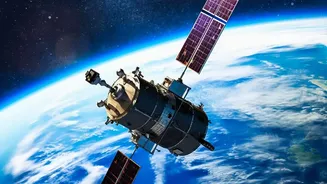
With a warning in hand, satellite operators can take action to protect their multi-million dollar assets. The most common defensive measure is to put the spacecraft into 'safe mode'. This is a minimalist operational state where all non-essential systems, particularly sensitive scientific instruments and electronics, are shut down. The satellite focuses only on core functions: keeping its solar panels pointed at the sun for power, maintaining thermal balance, and listening for commands from mission control. Operators might also reorient the satellite to present its most shielded side to the incoming particle storm, much like turning a ship's bow into a large wave. For satellites in Low Earth Orbit (LEO), another concern is increased atmospheric drag. A solar storm heats and expands Earth's upper atmosphere, which can cause LEO satellites to lose altitude faster than normal. By receiving advance warnings, operators can sometimes command the satellite to boost its orbit ahead of the storm. This constant monitoring and proactive defense is an invisible shield that keeps our global communications, navigation, and data networks running smoothly.