






A New Cosmic Puzzle
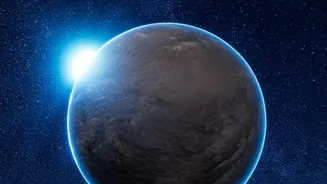
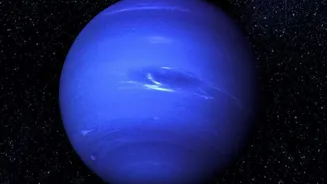
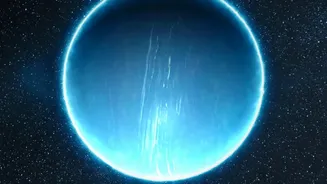
Imagine a world bigger than Earth but smaller than Neptune, orbiting its star so closely that its atmosphere is perpetually hot. These are 'warm Neptunes', and they are among the most common types of planets found in our galaxy, yet have no direct parallel
in our own solar system. Recent observations, particularly from the James Webb Space Telescope (JWST), have begun to peel back the hazy layers of these mysterious worlds, and they've found something perplexing: the chemical fingerprint of methane. This might not sound revolutionary, given methane is abundant in our own solar system's gas giants, but on a warm planet, it's a chemical conundrum.
Why Methane Should Not Be There
According to the established rules of atmospheric chemistry, methane shouldn't exist in large quantities on a warm planet. The logic was simple: the same stellar energy that heats the planet should also provide the energy to break down fragile methane molecules. At the high temperatures found on warm Neptunes, basic models predicted that methane (CH4) would be rapidly destroyed, with more stable molecules like carbon monoxide (CO) and carbon dioxide (CO2) dominating the atmosphere. Finding significant amounts of methane is like finding a snowman in a desert; its very presence suggests something is actively working against the environment's natural tendency to melt it.
Rewriting the Chemical Rulebook
The unexpected presence of methane forces scientists to abandon simple models of atmospheric equilibrium. The new leading theory is that these planets are in a state of 'disequilibrium chemistry'. This means that even as the heat and light from the star are destroying methane in the upper atmosphere, there must be a powerful and rapid process that is constantly replenishing it from below. One strong possibility is that the planet's interior is much hotter than previously assumed, driving vigorous vertical mixing that dredges up methane manufactured in the deeper, cooler layers of the atmosphere and brings it to the top before it can be destroyed. Another theory suggests the planet's core itself could be releasing the gas, or that unknown chemical pathways are creating methane under conditions we don't yet understand.
A 'Super-Venus' or Water World?
These findings are part of a broader effort to classify these strange worlds. For years, astronomers debated whether sub-Neptunes like GJ 1214 b were rocky 'super-Earths' with thick atmospheres or smaller versions of Neptune with a hydrogen-helium envelope. JWST's ability to peer through the planet's thick haze has revealed a world rich in heavy elements, with some studies pointing towards a carbon-dioxide-heavy atmosphere, earning it the nickname 'super-Venus'. However, other observations suggest the presence of water vapor, keeping the idea of a 'water world' in play. The presence of methane adds another layer to this complex picture, suggesting a dynamic world where multiple chemical processes are competing.
Implications for the Search for Life
While warm Neptunes themselves are not considered prime candidates for life as we know it, understanding their chemistry has profound implications for the search for habitable worlds. Methane is considered a potential 'biosignature'—a gas that could indicate the presence of biological processes. On Earth, the vast majority of atmospheric methane is produced by living organisms. The discovery of non-biological methane on warm Neptunes helps scientists refine their models and understand the various ways this gas can be produced abiotically. By studying these extreme cases, researchers can better differentiate between a planet with interesting geology and one that might actually host life, making future detections on Earth-like rocky planets more robust.