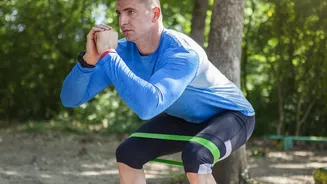







Looking for a simple, equipment-free way to build powerful legs for running and walking? The walking lunge is a dynamic exercise you can do anywhere outdoors, offering a potent combination of strength, stability, and mobility in a single move.
Why Walking Lunges Are a Game-Changer
Unlike static
exercises, the walking lunge is a dynamic, functional movement that closely mimics the motion of running and walking. Each step forward challenges your body to control momentum, maintain balance, and generate power, all at once. This makes it an incredibly efficient exercise for developing functional lower-body strength. By working one leg at a time, a practice known as unilateral training, walking lunges also expose and help correct strength imbalances between your left and right sides. Many athletes and runners have a dominant leg that unconsciously takes on more work, and lunges force the weaker leg to catch up, leading to a more balanced and injury-resistant stride.
The Muscles Behind the Movement
Walking lunges are a comprehensive lower-body workout, engaging several key muscle groups with every repetition. The primary muscles targeted are the quadriceps (front of the thigh), which control your descent, and the gluteus maximus (your largest glute muscle), which powers you back up. Alongside these, the hamstrings at the back of the thigh work to stabilize the knee joint. But the benefits don't stop there. Smaller stabilizing muscles in your hips, like the gluteus medius, work hard to keep your pelvis level and prevent your knee from caving inward. Your core muscles, including your abs and obliques, must also fire to keep your torso upright and stable as you move from one lunge to the next.
How to Perform a Perfect Walking Lunge
Proper form is crucial to maximize benefits and prevent injury. Start by standing tall with your feet hip-width apart and your core engaged. Take a controlled step forward with your right foot, about two feet or a comfortable stride length. As your foot lands, lower your hips until both knees are bent at approximately a 90-degree angle. Your front thigh should be parallel to the ground, and your front knee should be aligned over your ankle, not drifting past your toes. Your back knee should hover just above the ground without touching it. From this lowered position, press firmly through your right heel to drive your body upward and forward. Bring your left foot forward to step directly into the next lunge, alternating legs as you travel.
Common Mistakes to Avoid
A few common form errors can reduce the effectiveness of walking lunges and increase your risk of injury. One of the biggest mistakes is letting the front knee travel too far past the toes, which places unnecessary stress on the knee joint. Another is leaning your torso too far forward, which can strain your lower back and takes the focus off your glutes. Keep your chest up and look forward to maintain an upright posture. Also, watch for your front knee caving inward; this is often a sign of weak hip stabilizers. Focus on keeping your knee aligned with your second toe. Finally, avoid taking steps that are too long or too short. An overly long stride can stress the hamstring and hip, while a short step limits your range of motion.
Adding Lunges to Your Routine
Walking lunges are versatile and can be incorporated into your fitness schedule in several ways. Some runners like to perform a set of 20 to 50 walking lunges as part of their warmup to activate the glutes and improve posture before a run. They can also serve as a standalone strengthtraining exercise. For beginners, starting with 2–3 sets of 10–12 reps per leg is a great goal. As you get stronger, you can increase the number of reps or add resistance by holding dumbbells. Because they are a strengthbuilding exercise, it's best to avoid doing them every single day to allow your muscles time to recover and rebuild. One to three times per week is an effective frequency for building strength and seeing results.