


The Search for Worlds Beyond
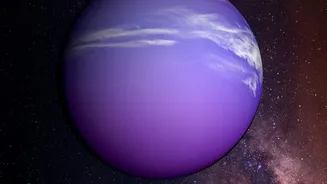
For centuries, humanity has wondered if we are alone in the universe. The first step in answering that question is finding planets outside our solar system, known as exoplanets, that might have the right conditions for life. The key ingredient in that search
is water. While we have confirmed thousands of exoplanets, understanding what they are made of has been a significant challenge. Most are too far away and too faint to be seen directly. Instead, astronomers look for clues hidden in the light from their parent stars, and for that, they need incredibly powerful tools.
Catching a Planet's Shadow
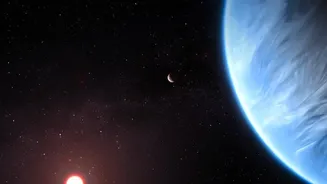
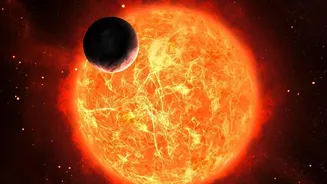
One of the most effective methods for studying an exoplanet's atmosphere is called transit spectroscopy. This technique relies on a specific alignment: from our point of view, the planet must pass directly in front of its star, an event known as a transit. As the planet transits, the star's light dims slightly, which is how many exoplanets are discovered in the first place. But more importantly, a tiny fraction of that starlight filters through the planet's atmosphere. The gases in the atmosphere absorb certain wavelengths, or colors, of light, leaving a chemical fingerprint embedded in the starlight that reaches our telescopes. By analyzing which colors are missing, scientists can determine the composition of that distant atmosphere.
Webb's Infrared Advantage
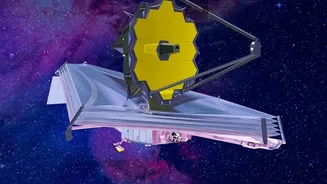
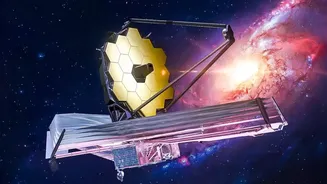
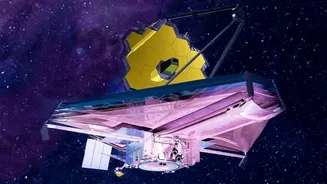
This is where the James Webb Space Telescope (JWST) represents a monumental leap forward. While its predecessor, the Hubble Space Telescope, could detect water, Webb's capabilities are far more advanced because it is optimized to see the universe in infrared light. Molecules like water vapor, methane, and carbon dioxide happen to be excellent absorbers of specific infrared wavelengths. When starlight passes through an atmosphere containing water, the water molecules absorb light at these key infrared frequencies, creating a distinct and measurable signature that was difficult for previous telescopes to capture with such clarity. Webb’s instruments can spread this infrared light into a detailed spectrum, much like a prism creates a rainbow, allowing scientists to see the tell-tale gaps left by water vapor.
The Power of Precision Optics and Instruments
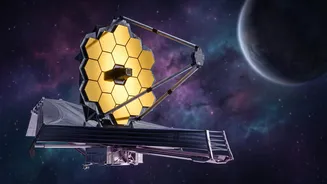
The headline-making discoveries are made possible by Webb’s incredible optics and a suite of highly specialized instruments. Its massive 6.5-meter primary mirror, composed of 18 gold-coated hexagonal segments, allows it to collect far more faint infrared light than any previous space telescope. This light-gathering power is crucial for detecting the incredibly subtle dimming caused by an exoplanet's atmosphere. The light is then channeled to instruments like the Near-Infrared Spectrograph (NIRSpec) and the Near-Infrared Imager and Slitless Spectrograph (NIRISS). These devices are designed specifically to perform high-precision spectroscopy on exoplanets. They can capture a broad range of infrared wavelengths simultaneously, giving astronomers a comprehensive view of an atmosphere's chemical makeup in a single observation.
From Water Vapor to Habitable Worlds
It is important to understand what these detections mean. When scientists announce they've found water on an exoplanet like WASP-96 b or in a planet-forming disk like that of PDS 70, they are talking about water vapor in the atmosphere, not liquid oceans on the surface. The presence of water vapor is an essential first clue, indicating that a key ingredient for life exists. However, a planet's habitability also depends on many other factors, such as its temperature, pressure, and whether it has a rocky surface. Some detections have even been made on scorching hot gas giants where life as we know it couldn't survive. But by proving that we can reliably detect water vapor, Webb is building a toolkit that can be applied to smaller, rocky, more Earth-like planets.