


The Old Cosmic Blueprint
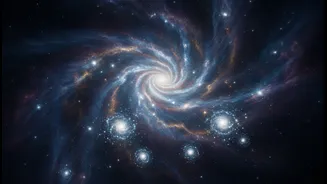
For a long time, our understanding of how galaxies grew was based on a 'hierarchical' model. The idea was that small, fledgling galaxies slowly pulled in gas and occasionally merged with one another over billions of years, gradually building up to the massive,
structured galaxies we see today, like our own Milky Way. This theory was supported by observations from telescopes like Hubble and sophisticated computer simulations. These models predicted a relatively orderly, albeit slow, construction process. Mergers were certainly part of the picture, but they were thought to be less common in the universe's first billion years, with the pace picking up later. This framework made sense, but it had a few nagging problems, like the existence of surprisingly massive and 'mature' galaxies that seemed too evolved for their young age.
A New, Chaotic View from Webb
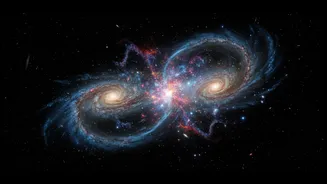
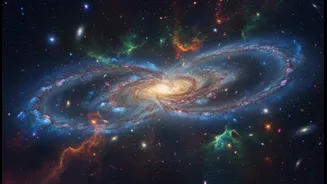
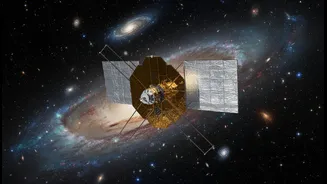
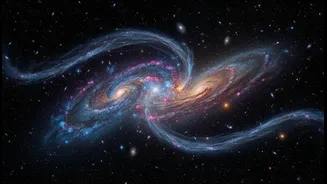
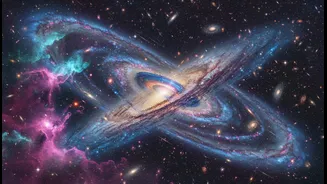
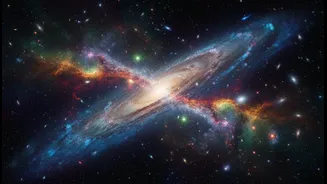
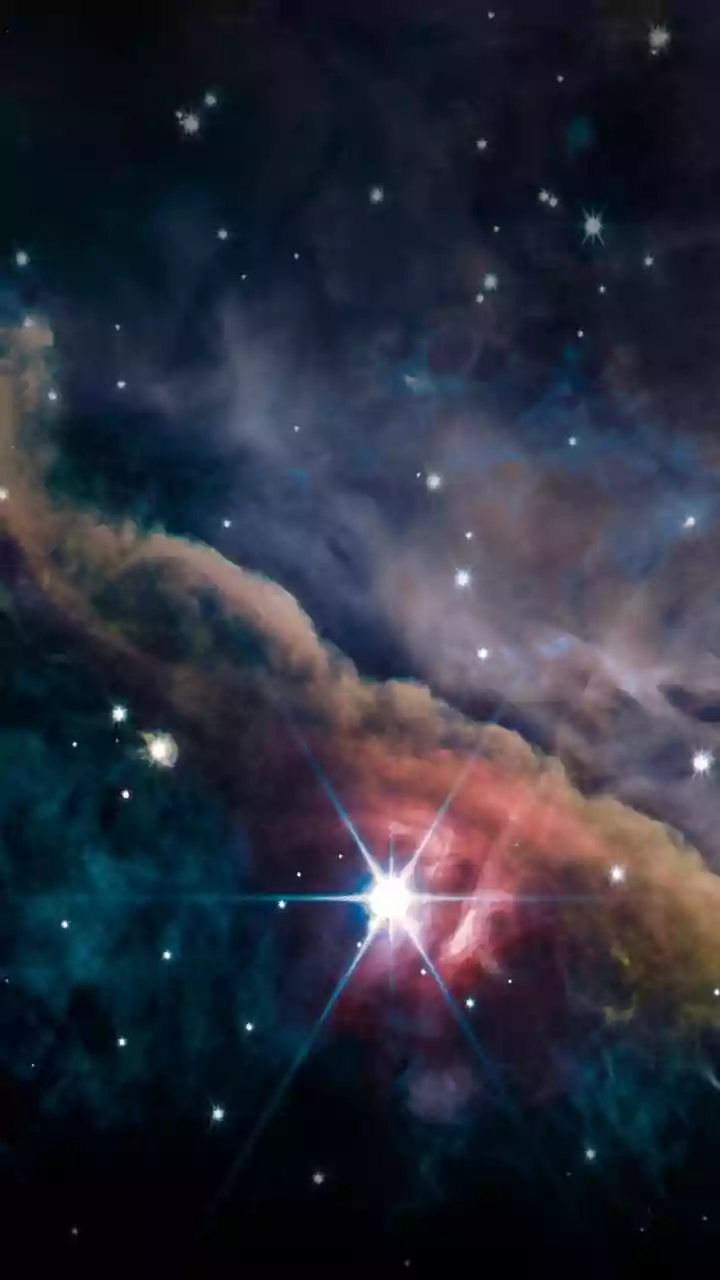
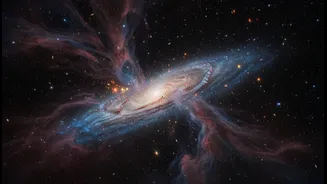
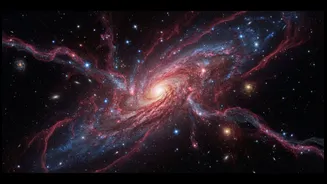
Enter the James Webb Space Telescope (JWST). With its unparalleled sensitivity and ability to peer deeper into the infrared spectrum, Webb is looking back to a time just a few hundred million years after the Big Bang. And what it's seeing is shaking up the old theories. Instead of isolated galaxies growing peacefully, Webb has revealed a cosmic mosh pit. Where the Hubble telescope saw a single large galaxy, Webb's sharper eye often sees a whole cluster of smaller, fainter galaxies furiously crashing into each other. These early cosmic neighbourhoods are proving to be much busier and more violent than previously thought. Studies analyzing Webb data have found that mergers were not a rare occurrence but a dominant force, happening far more frequently than the models predicted for that era.
Rewriting the Merger Rate
The new findings aren't just a minor adjustment; they represent a fundamental shift. Recent analyses of JWST data have shown that the galaxy merger rate increased dramatically up to about 1.5 billion years after the Big Bang and then stabilized at a high level. In fact, some studies suggest that mergers could be responsible for as much as 71% of the stellar mass growth in galaxies during this period. This is a stark contrast to older models, where that number was estimated to be much lower, between 5% and 30%. What this means is that cosmic collisions were not just an occasional event but possibly the primary way galaxies bulked up in their infancy. This frenzy of mergers helps solve the mystery of those unexpectedly massive early galaxies; they weren't just fast growers, they were the product of a constant stream of collisions.
Why Were the Predictions Off?
The discrepancy comes down to a matter of vision. Previous telescopes simply weren't powerful enough to see the full picture. They could spot the brightest, largest galaxies but missed the swarms of smaller, fainter ones that were constantly interacting just below the threshold of detection. The simulations, in turn, were based on this incomplete observational data, leading them to underestimate the density and chaotic nature of the early cosmos. With Webb's ability to resolve these clusters of interacting dwarf galaxies, astronomers now realize that what they once thought was a single entity was often a complex merger in progress. It's like looking at a city from a distance at night; you might only see the brightest skyscrapers, missing the bustling network of streets and traffic below.
A New Chapter in Cosmic History
This discovery does more than just update a few numbers in a textbook. It fundamentally changes our narrative of galaxy evolution. It suggests that galaxies like the Milky Way likely had a much more violent and dynamic youth than we imagined. The frequent mergers would have triggered intense bursts of star formation, rapidly enriching these young galaxies with heavier elements. These collisions also played a crucial role in clearing out the dense fog of neutral hydrogen gas that filled the early universe, allowing light to travel freely—a key event known as the Epoch of Reionization. By understanding this early, chaotic phase, we get a much clearer picture of the initial conditions that eventually led to the grand, structured universe we inhabit today.