




A Legacy of State-Led Success
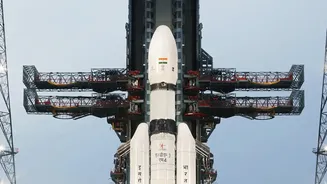
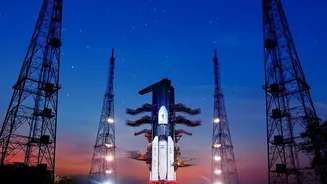
For over five decades, ISRO has been the undisputed champion of India's space ambitions. From its early rocket launches to the historic Chandrayaan missions and landing near the moon's south pole, the agency has operated as a vertically integrated powerhouse,
handling everything from research and development to building and launching rockets. This state-led model made India one of only a handful of spacefaring nations, developing critical satellite infrastructure for communication, weather forecasting, and national security. For years, private industry's role was largely confined to being suppliers for ISRO's grand projects, with almost 80% of launch vehicle budgets being invested in Indian industries.
The New Space Race: Private Ambitions Take Flight
The landscape began to shift dramatically in 2020 when the government opened the space sector to private enterprise. This policy shift, institutionalised by the Indian Space Policy 2023, was designed to do one thing: scale up. India’s space economy, currently valued at around $8.4 billion, aims to hit $44 billion by 2033. Officials recognised that this ambitious target could not be met by ISRO's resources alone. The reforms sparked a boom, with the number of space startups growing from a handful in 2020 to over 450 today. Companies like Skyroot Aerospace and Agnikul Cosmos are now building their own launch vehicles, while others focus on satellite manufacturing and data services, creating a dynamic new commercial ecosystem.
Clarifying the Mission: ISRO’s Evolving Role
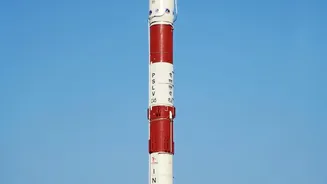
Recent speculation about privatisation prompted ISRO to issue a firm clarification: the agency is not being sold off or diminished. Instead, its role is evolving. The new strategy is to create an “ISRO-led national space ecosystem.” This means ISRO will hand over mature, routine operations—like the manufacturing of the workhorse Polar Satellite Launch Vehicle (PSLV)—to private and public-sector companies. This frees up ISRO’s elite scientific talent and resources to focus on what they do best: pushing the frontiers of science and technology. This includes advanced R&D, deep-space exploration, human spaceflight (like the Gaganyaan mission), and developing next-generation reusable launch systems. It will also continue leading strategic national missions and developing critical technologies too complex for the private sector to tackle alone.
IN-SPACe: The Bridge Between Old and New
To manage this new, crowded airspace, the government established the Indian National Space Promotion and Authorization Center (IN-SPACe) in 2020. Think of it as the sector's new traffic controller and facilitator. As a single-window agency, IN-SPACe is responsible for promoting, authorising, and supervising the activities of all non-government entities. Whether a startup wants to launch a satellite, test a new rocket engine, or use ISRO's world-class facilities, it goes through IN-SPACe. This body ensures a level playing field and streamlines the process, bridging the gap between the established government agency and the energetic new players. Another entity, NewSpace India Limited (NSIL), focuses on the commercialisation of mature technologies developed by ISRO.
A Collaborative Cosmos, Not a Competitive One
The message from both ISRO and government officials is clear: this is a partnership, not a rivalry. Pawan Goenka, the chairman of IN-SPACe, stated that ISRO will remain the “bedrock” of India's space program. The goal is to create a larger, stronger, and more globally competitive Indian space industry. By having private firms handle manufacturing and commercial launches, the entire ecosystem becomes more robust and efficient. This allows India to dramatically increase its launch capacity, with a target of 50 launches per year, a goal that would be impossible for ISRO alone. This collaborative model is seen as essential for achieving India’s ambitious Space Vision 2047, which includes building the Bharatiya Antariksh Station (Indian Space Station) by 2035 and landing an Indian astronaut on the Moon by 2040.