






Deep beneath the Franco-Swiss border, an experiment is hunting for ghost-like events that could rewrite our rulebook for the universe. Physicists are looking for cracks in our most successful theory of particle physics, and they are doing it by watching
particles decay.
The Universe's Incomplete Rulebook
For decades, physicists have relied on the Standard Model of particle physics. It’s a wildly successful theory that describes the fundamental particles—like quarks and electrons—and the forces that govern their interactions. It predicted the existence of particles like the Higgs boson years before it was found. But scientists have long known it is incomplete. The Standard Model has no explanation for gravity, nor can it account for the mysterious dark matter and dark energy that make up about 95% of the cosmos. It also doesn't explain why the universe is made of matter when the Big Bang should have created equal parts matter and antimatter. These gaps suggest there is a deeper, more fundamental theory out there, a 'new physics' waiting to be discovered.
Enter the LHCb: A Specialist Particle Detective
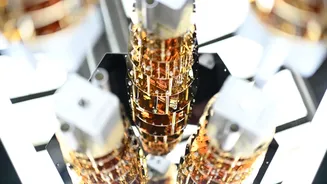
At CERN's Large Hadron Collider (LHC), the world's most powerful particle accelerator, several massive experiments are trying to find answers. While detectors like ATLAS and CMS are general-purpose giants, the LHCb (Large Hadron Collider beauty) experiment is a specialist. Its primary mission is to study particles containing a 'beauty' quark, also known as a 'b' quark. These heavy, unstable particles are produced in huge numbers by the LHC's proton collisions but decay in just a trillionth of a second. The LHCb detector is a 21-metre-long spectrometer designed to precisely track the products of these fleeting decays, hunting for anomalies. It's in these decays that signs of new, undiscovered particles or forces might reveal themselves.
The Search for One-in-Ten-Billion Events
The strategy is to look for extremely rare events—decays so infrequent they are almost forbidden by the Standard Model. The logic is simple: if an unknown particle exists, it could subtly influence these decays, making them happen slightly more or less often than predicted. Recently, in early November 2026, the LHCb collaboration announced a major milestone: the first single-experiment evidence for the decay of a beauty particle (the B⁰ meson) into two muons. This is a process predicted to happen only once in every ten billion decays. After decades of searching, the upgraded LHCb detector, which can record data five times faster than before, was sensitive enough to find it. The result, with a statistical significance of 3.2 sigma, is strong 'evidence' but not yet a 'discovery', which requires a higher threshold.
What Do the Results Mean?
So far, the measurements of this incredibly rare decay are consistent with the predictions of the Standard Model. While this doesn't point to new physics just yet, the achievement itself is a massive breakthrough. By successfully measuring such a rare process, physicists have demonstrated a new level of precision. This allows them to place much tighter constraints on what any potential new theories could look like. It’s like searching for a lost key in a vast field; even if you don't find the key, ruling out a large section of the field narrows down where you need to look next. This result sharpens the tools for the hunt ahead, pushing the search for new particles into an unexplored energy range sometimes called the 'Zeptoverse'.
India’s Crucial Role in the Global Quest
This global scientific endeavor has significant contributions from India. Indian scientists and institutions have been involved with CERN's LHC projects for decades, contributing hardware, software, and skilled expertise. For the LHC accelerator itself, India provided thousands of precision magnets and other critical components. Indian researchers have also been central to the ALICE and CMS experiments. More specifically for LHCb, Indian scientists are part of the vast international collaboration of over 1400 members. India also hosts Tier-2 centres for the Worldwide LHC Computing Grid, providing the immense computational power needed to analyse the petabytes of data generated by the collisions, including the rare decay events sought by LHCb.