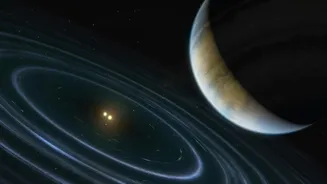




Our solar system has enjoyed billions of years of relative stability, but all good things must end. While we've long known the Sun's death will consume the inner planets, new research paints a surprisingly chaotic future for the distant giants.
The Sun’s Final Act
In about
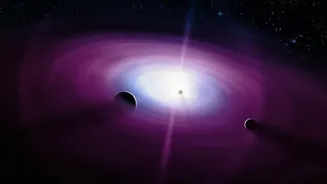
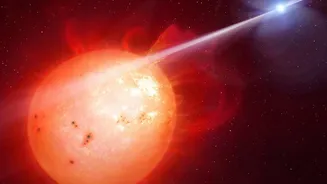
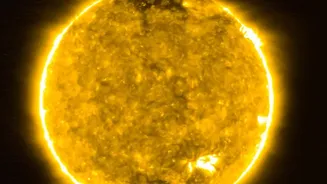
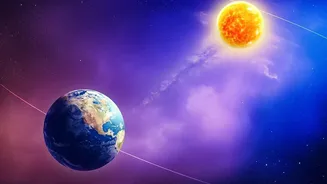
five billion years, the Sun will exhaust the hydrogen fuel in its core and begin its transformation into a red giant. It will swell to more than 100 times its current size, a fiery expansion that will engulf and destroy Mercury, Venus, and almost certainly Earth. After this phase, our star will shed its outer layers and collapse into a white dwarf — a dense, Earth-sized remnant of its former self. For decades, scientists believed this process would be relatively gentle on the outer solar system. The loss of about half the Sun's mass would cause the orbits of Jupiter, Saturn, Uranus, and Neptune to expand, but they were expected to settle into a new, stable configuration for an almost unimaginable length of time, perhaps for 100 billion years or more.
A Not-So-Quiet End
A recent study published in The Astrophysical Journal Letters challenges this peaceful picture. The new model, developed by researchers from Caltech and the University of Michigan, suggests the Sun won't lose mass smoothly. Instead, it will likely happen through thousands of violent, uneven bursts of material ejected in random directions. Each of these 'stochastic kicks' will give the dying Sun a small nudge, subtly but significantly altering its gravitational pull on the remaining planets. Over millions of years, the cumulative effect of these random nudges creates a 'random walk' for the planets' orbits, introducing an element of unpredictability and chaos that previous models, which assumed a smooth mass loss, did not account for.
Cosmic Billiards
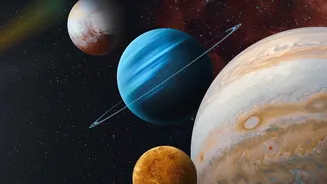
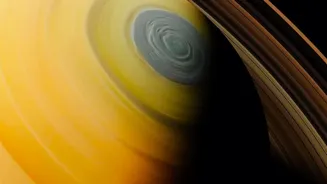
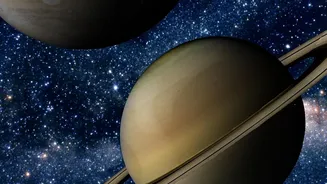
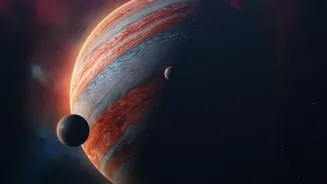
The consequences of this chaotic process could be dramatic. The researchers ran hundreds of computer simulations to model the future of the outer solar system under these new assumptions. In a significant number of scenarios, the stable, clockwork orbits we know today descend into disarray. The simulations showed that in roughly 40% of cases, the outer solar system would experience major disruption even before the Sun fully becomes a white dwarf. The results showed planets being thrown into eccentric, crisscrossing orbits. In some simulations, Uranus and Neptune swapped places, while in others, the magnificent ringed planet Saturn was ejected from the solar system entirely, destined to become a rogue planet wandering interstellar space.
A Drastically Shorter Timeline
Perhaps the most startling finding is the drastically reduced timeline for this instability. Where previous estimates suggested the outer planets could remain stable for 100 billion years or even longer, the new model predicts that widespread chaos could unfold within just a billion years of the Sun becoming a white dwarf. In fact, in about 90% of the simulations reflecting the most realistic mass-loss conditions, the outer solar system self-destructed within three billion years. This suggests that the final chapter of our solar system will be far more violent and arrive a billion times sooner than previously thought.
Why This Cosmic Forecast Matters
While this cosmic drama will unfold long after humanity is gone, it has profound implications for astronomy. It reshapes our understanding of how planetary systems evolve and die. The model suggests that dying stars could be a major source of the free-floating 'rogue planets' that are thought to be as numerous as stars in our galaxy. By studying the likely fate of our own celestial neighbours, scientists can better interpret what they see in distant star systems. It provides a new framework for understanding the architectures of planetary systems around other white dwarfs, offering clues about what might have been lost along the way.