


An Unexpected Discovery
The story begins with an object named (248370) 2005 QN173. First spotted in 2005, it was classified as a typical main-belt asteroid, one of millions of rocky bodies orbiting the Sun in the vast expanse between Mars and Jupiter. For years, it behaved exactly
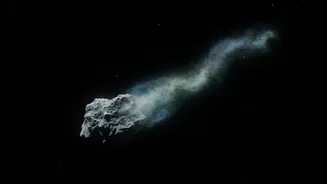
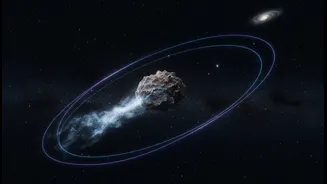
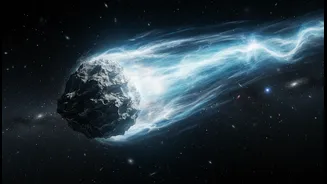
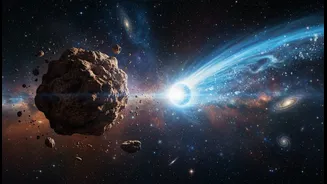
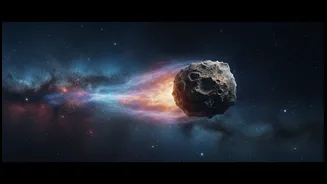
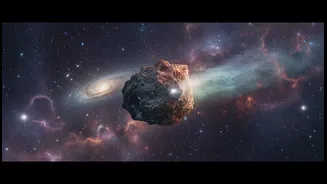
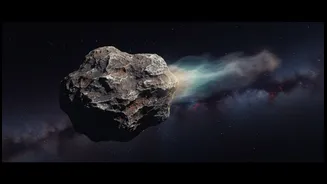
as expected: as an inactive, point-like source of light. But in July 2021, astronomers using the Asteroid Terrestrial-impact Last Alert System (ATLAS) survey noticed something bizarre. The asteroid was no longer just a dot; it had developed a long, narrow tail of dust stretching over 700,000 kilometres. This was puzzling because asteroids, unlike comets, are not supposed to have tails. This single observation kicked off a scientific investigation to understand how and why a supposedly dead rock was showing signs of life.
The First Clue: Dust and a Tail
The presence of dust activity was the first major clue that 2005 QN173 was no ordinary asteroid. Tails are the signature feature of comets. Comets are often called "dirty snowballs" because they are mixtures of ice, rock, and dust. When their journey takes them closer to the Sun, the ice heats up and turns directly into gas in a process called sublimation. This escaping gas drags dust and rock particles along with it, forming a glowing atmosphere called a coma and a visible tail that points away from the Sun. Asteroids, having formed closer to the Sun, are thought to be mostly rock and metal, with little to no ice to sublimate. The discovery of a tail on 2005 QN173 suggested it was behaving like a comet, ejecting material into space.
The Second Clue: Follow-up Imaging
To confirm what was happening, astronomers turned more powerful telescopes towards the object for follow-up imaging. These observations, conducted over several months, confirmed the persistent activity. The tail was real, and it was long-lasting. But the mystery deepened. Digging through archival data, scientists found images from 2016 that showed the very same asteroid was active during a previous trip around the Sun. This recurrent activity was a crucial piece of evidence. It made it highly unlikely that the dust was caused by a one-off event, like a collision with another asteroid. Instead, the repeated outgassing near its closest approach to the Sun strongly pointed towards the sublimation of ice, just like a classic comet. The rock was acting like a comet, but its address said it was an asteroid.
The Final Piece: Orbit Analysis
This is where orbit analysis became critical. Astronomers can tell a lot about an object's origin from its path around the Sun. Comets typically have long, highly elliptical orbits that take them from the frigid outer solar system (like the Kuiper Belt or Oort Cloud) into the inner solar system and back out again. Asteroids, on the other hand, tend to have more circular orbits and are confined to the main asteroid belt. Analysis of 2005 QN173's orbit confirmed it was a long-term resident of the asteroid belt. It wasn't a visitor from the outer solar system just passing through. This confirmed that 2005 QN173 was a member of a rare and fascinating class of objects known as "main-belt comets" or "active asteroids" – bodies with the orbit of an asteroid but the physical characteristics of a comet.
A Blurring of Boundaries
The discovery of objects like 2005 QN173 blurs the once-clear line between comets and asteroids. These celestial hybrids are scientifically important because they challenge our models of how the solar system formed. The main asteroid belt was thought to be too warm for water ice to have survived for billions of years. The existence of main-belt comets suggests that water ice might have been more widespread in the inner solar system than previously believed. This has profound implications for understanding one of science's biggest questions: how Earth got its water. While comets from the outer solar system were long considered the primary source, their water composition doesn't perfectly match Earth's oceans. The discovery of these icy asteroids, which formed closer to home, provides a compelling alternative source for the water that makes life on our planet possible.