



India’s Next Interplanetary Frontier
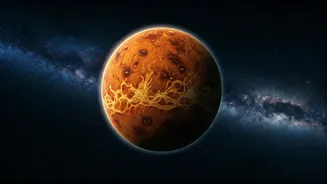
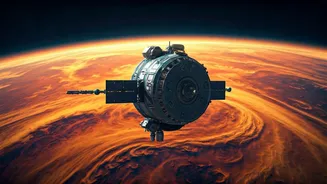
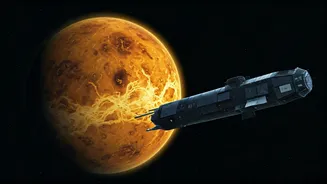
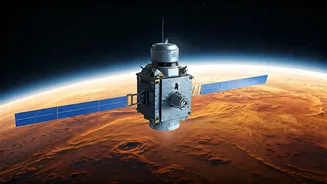
Following the historic successes of its Mars and Moon missions, the Indian Space Research Organisation (ISRO) is setting its sights on Venus. The proposed Venus Orbiter Mission, unofficially known as Shukrayaan-1, represents India's next great leap in planetary
exploration. Scheduled for a potential launch in 2028 aboard the powerful LVM-3 rocket, the mission aims to place an orbiter into a long-term orbit around Earth's "twin sister" to study it in unprecedented detail. While the journey is ambitious, the rewards are not just about planting a flag in a new cosmic territory. The mission is designed to unravel the mysteries of Venus, from its cloud-covered surface to its complex atmospheric dynamics. This endeavour places India among a select group of global space agencies investing in understanding our closest planetary neighbour.
Venus: A Natural Laboratory for Climate Change
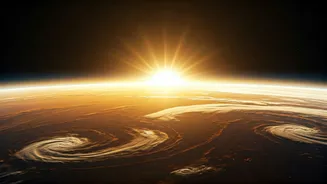
Often called Earth's twin due to its similar size and mass, Venus is anything but hospitable. Its atmosphere is over 96% carbon dioxide, creating a runaway greenhouse effect that pushes surface temperatures above 460°C. It is a world where immense pressure and clouds of sulfuric acid are the norm. However, it is precisely these extreme conditions that make Venus a perfect natural laboratory. Scientists believe Venus may have once hosted liquid water oceans, much like Earth, before a catastrophic climate shift transformed it. By studying how Venus evolved from a potentially habitable world into a scorching hothouse, scientists can gain invaluable insights into the tipping points of planetary climate systems. This makes the Shukrayaan mission not just an exploration, but a crucial investigation into a large-scale climate experiment.
The Science Behind the Mission
To peer beneath the thick Venusian clouds, Shukrayaan-1 will be equipped with a suite of advanced instruments. The flagship payload is a high-resolution Synthetic Aperture Radar (SAR), which can map the planet's surface in detail, revealing geological features like volcanoes and lava flows regardless of weather or darkness. Another groundbreaking instrument is a ground-penetrating radar, which will conduct the first-ever subsurface study of Venus. Other payloads, developed with international partners from Sweden, Russia, and Germany, will analyze the composition and dynamics of the atmosphere, study how the solar wind interacts with the planet, and map thermal emissions. These tools will work in concert to build a comprehensive picture of Venus's structure, from its hidden surface to the top of its atmosphere, providing data that existing models can only dream of.
From Venusian Clouds to Monsoon Forecasts
The link between studying Venus and improving Indian weather forecasts lies in the power of atmospheric modelling. The complex computer models used to predict Earth's weather, including the crucial Indian monsoon, are based on fundamental laws of physics and fluid dynamics. By testing these models against the extreme atmospheric conditions on Venus—with its super-rotating winds and dense cloud systems—scientists can identify weaknesses and refine their accuracy. Data on how Venus's atmosphere circulates and transports heat provides a stress test for the very same principles used to forecast cyclones and weather patterns on Earth. A model that can accurately simulate the hellish weather on Venus is a model that can be trusted to perform with greater precision for Earth, leading to more reliable and timely warnings for extreme weather events back home.
A Warning and a Guide for Earth's Future
Beyond daily weather, the Shukrayaan mission has profound implications for understanding long-term climate change. The runaway greenhouse effect on Venus serves as a stark cautionary tale for Earth. By studying its atmospheric chemistry and history, scientists can better understand the mechanisms that drive dramatic climate shifts. This knowledge is vital for validating and improving the climate models used to project Earth's future warming scenarios. Understanding how Venus lost its water and developed its thick, heat-trapping atmosphere can provide critical clues about planetary habitability and the resilience of Earth's own climate system. The mission will contribute to a global effort to understand not only how planets evolve, but also how to safeguard the delicate atmospheric balance that makes life on our own world possible.