






Shadow boxing is one of the most accessible fitness tools available, offering a full-body workout with no equipment needed. But its true power is unlocked not through speed, but through control. Here’s how to master your movements.
Why Control Is King
Swinging your arms wildly
in the air might make you sweat, but it isn't effective shadow boxing. The goal is to move with intention. Controlled movements transform the exercise from simple cardio into a highly focused drill that builds muscle memory, coordination, and functional strength. When you focus on form over frantic energy, you engage your core, hips, and legs, turning each punch into a full-body action. This precision is also your best defense against injury. Throwing punches without a target to absorb the impact puts stress on your joints, particularly your elbows and shoulders. By stopping your punches just before full extension, you protect your joints from hyperextension and build the stabilising muscles needed for safe, powerful movements.
The Foundation: Your Stance and Footwork
Every controlled movement begins from the ground up. Before throwing a single punch, establish a solid boxing stance. Stand with your feet shoulder-width apart, with your lead foot forward and your rear foot at a 45-degree angle for stability. Keep your knees slightly bent and your weight evenly distributed. Boxing happens on the balls of your feet, not flat-footed. Practice staying light and mobile, moving forward, backward, and side-to-side. This constant, controlled movement is essential for balance and agility, and it ensures your entire body is engaged in the workout, not just your arms.
Executing Punches with Precision
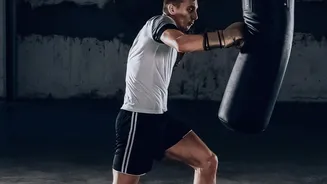
The secret to a controlled punch is generating power from your hips and core, not just your arm. Think of your punches as a whip, not a push. For every punch—whether a jab, cross, hook, or uppercut—focus on rotating your hips and torso to drive the movement. Exhale sharply with each strike. Most importantly, the punch doesn't end at full extension. The speed at which you snap your hand back to your guard position is just as critical. This not only improves your technique but also protects you from imaginary counters, building good defensive habits. Start by performing movements slowly to perfect the technique, then gradually increase your speed as you gain confidence and control.
The Mental Game of Movement
Shadow boxing is as much a mental exercise as it is a physical one. To keep your movements purposeful, you must visualize an opponent. This practice turns aimless punching into a strategic drill. Imagine an opponent's height, stance, and actions. Are they throwing a jab you need to slip? Are they open for a counter-cross? This mental engagement keeps you focused and ensures every move has a purpose, whether it's an attack, a defensive slip, or a pivot to create a new angle. This act of visualization is what separates a great shadow boxing session from a mediocre one.
Common Control-Related Mistakes
Several common errors can undermine your control and lead to bad habits or injury. The most frequent is hyperextending or locking your elbows on punches, which can strain the joint. Always stop just short of full extension. Another mistake is being flat-footed, which kills your mobility and power. Stay on the balls of your feet. Many beginners also forget to move their head or practice defense, focusing only on offense. Remember to incorporate slips, rolls, and pivots after you throw combinations. Finally, avoid the temptation to throw long, unrealistic 20-punch combinations. Keep your combos short, crisp, and purposeful, always returning to your defensive guard.