



A New Eye on the Cosmos
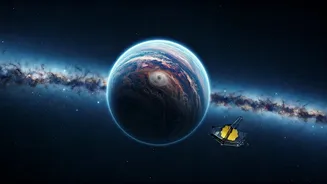
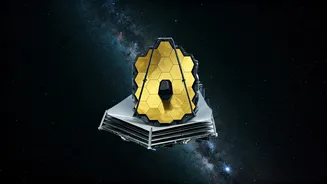
The game-changer in this cosmic detective story is the James Webb Space Telescope (JWST). Launched as the successor to the Hubble Space Telescope, JWST is an engineering marvel designed to see the universe in infrared light. This is crucial because the chemical
signatures of molecules in a planet's atmosphere, including water, are most visible at these wavelengths. Before JWST, getting a clear look at the atmospheres of smaller, rocky planets was incredibly difficult. But Webb’s enormous mirror and ultra-sensitive instruments give astronomers the power to not just find planets, but to analyze what their skies are made of, marking a huge leap forward in the quest to characterize worlds beyond our own.
The Science of Starlight
The primary technique used to sniff out alien atmospheres is called transmission spectroscopy. It’s a beautifully simple concept. First, scientists wait for a planet to pass in front of its host star from our point of view—an event called a 'transit'. As the star’s light filters through the upper layers of the planet’s atmosphere, the gases present absorb some of that light. Each molecule absorbs light at very specific, characteristic wavelengths, leaving a unique 'fingerprint' in the light spectrum that reaches the telescope. By capturing this filtered starlight, JWST can pick apart the light, see which colors are missing, and tell us exactly which molecules are in the planet's air.
Decoding the Water Signature
When water vapor is present, it creates a very distinct pattern of absorption in the starlight spectrum. Webb’s instruments are so precise they can detect these tiny dips in brightness at specific infrared wavelengths. For example, early observations of the gas giant WASP-96 b, located 1,150 light-years away, revealed the unambiguous signature of water. Similarly, observations of other worlds, like the super-Earth GJ 486 b, have shown tantalizing hints of water, though scientists are careful to rule out other sources, like water vapor present in the star itself. These detections are not just a simple yes-or-no; the strength of the signal can help scientists estimate the amount of water and the temperature of the atmosphere.
What 'Finding Water' Really Means
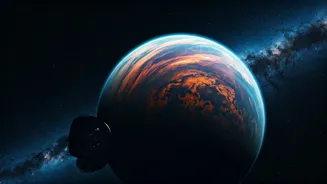
Detecting water vapor is a landmark discovery, but it doesn't automatically mean we've found a lush, ocean-covered paradise. Context is everything. The planet GJ 9827d, the smallest exoplanet where water vapor has been detected, is a case in point. With a surface temperature searing at around 400 degrees Celsius, it's as hot as Venus. If it has an atmosphere, it would be a punishing, steamy world, not a habitable one. The discovery could mean it’s a 'mini-Neptune' with a hydrogen-rich atmosphere containing some water, or it could be a rocky world enveloped in steam. The significance lies in showing that even small planets can have water-rich atmospheres, a crucial step in understanding planetary diversity.
A New Era of Exploration
The ability to detect water is just the beginning. The same techniques allow astronomers to search for other key molecules like methane, carbon dioxide, and even potential biosignatures—substances that could hint at the presence of life. With discoveries on planets like K2-18b, which showed methane and carbon dioxide in addition to water, scientists are building a complete inventory of planetary ingredients. This opens the door to understanding how planets form and evolve. Each detection, whether on a scorching gas giant or a small rocky world, provides another piece of the puzzle, pushing us closer to answering one of humanity’s oldest questions: Are we alone?