
The Menalon Trail: A Mythical Peloponnese Journey
Deep in the heart of the Peloponnese region of Arcadia, an area so idyllic its name became a byword for unspoiled wilderness, lies the Menalon Trail. This 75-kilometre path was the first in Greece to be certified by the European Ramblers' Association
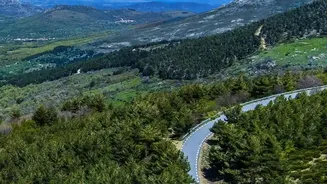
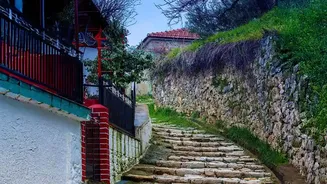
for its quality and safety. But its roots are far older. For centuries, these were the mule tracks and footpaths that connected nine traditional villages, allowing people to travel between remote mountain settlements and monasteries. Walking the Menalon Trail today is like stepping into a pastoral dream. The route follows the Lousios River gorge, passes through dense fir forests, and opens onto dramatic valley views. It’s a journey punctuated by history, taking hikers to cliffside sanctuaries like the 16th-century Prodromos Monastery and the ruins of the Old Philosophou Monastery, which dates back to 963 AD and served as a secret school during Ottoman rule. This trail is more than a hike; it’s an immersion into a slower, more authentic side of Greece, where stone villages and Byzantine history are around every bend.
The Corfu Trail: From Coast to Mountaintop
While many visitors know Corfu for its Venetian architecture and stunning beaches, the island’s true character is revealed along the Corfu Trail. Established in 2001, this 180-km route was designed to preserve the island's network of ancient donkey paths and forgotten shepherd tracks. It runs the entire length of the island, from the southern tip at Cape Asprokavos to the northernmost point at Agios Spiridon beach. Unlike a single ancient road, the trail is a clever stitching-together of historical pathways. It guides walkers through a staggering variety of landscapes: dense olive groves, quiet coastal tracks, sleepy hamlets, and cobbled footpaths leading to medieval fortresses like Angelokastro. The terrain is as varied as the history, from flat, easy sections to the challenging ascent of Mount Pantokrator, Corfu's highest peak, which offers panoramic views across to Albania and mainland Greece. While waymarking can be inconsistent, the experience offers a deep connection to the island, far from the bustling tourist resorts.
Crete's Minoan Paths: In the Footsteps of Kings
Crete is the cradle of the Minoan civilisation, and remnants of their world are etched into the landscape. Beyond the famous palace at Knossos, ancient paths crisscross the island, some of which can still be hiked today. One symbolic route is the 'Minoan Route' hike, an annual event that retraces the legendary path King Minos was said to have walked from the ancient city of Lyttos to the Dikteon Cave, where he supposedly received laws from his father, Zeus. This four-hour walk connects a series of historical and natural sites. Other trails, like the path through the 'Gorge of the Dead' on the E4 European route, were used by Minoans to bury their dead in cliffside caves. These routes are not just scenic hikes; they are archaeological experiences. Walking from the village of Krousonas through a gorge reveals a Minoan path that once connected major settlements, while other tracks pass by ancient Roman aqueducts, showcasing the layers of history that define the Cretan countryside.
The Via Egnatia: Walking a Roman Superhighway
Not all ancient paths were humble tracks. The Via Egnatia was a marvel of Roman engineering, a stone-paved highway built in the 2nd century BC to connect the Adriatic Sea with the Bosporus, effectively linking Rome with Constantinople. This artery of commerce and military power stretched for over 1,100 kilometres. It was travelled by soldiers, merchants, and missionaries, including Saint Paul, who used the road on his journeys to Philippi and Thessalonica. Today, while a modern highway follows its general course, preserved sections of the original stone-paved road can be walked in northern Greece, particularly near Kavala and the archaeological site of Philippi. Walking on these massive, carefully fitted stone slabs is a powerful experience, connecting you directly to the might of the Roman Empire and the countless travellers who passed this way over two millennia. It is a tangible link to a time when this road was one of the most important in the world.