




A 'New Star' Appears in the Heavens
In early October 1604, sky-gazers across Europe, China, and Korea noticed something astonishing. A 'new star' had suddenly ignited in the constellation Ophiuchus, the serpent-bearer. This visitor, which we now call SN 1604 or Kepler's Supernova, was no ordinary
star. Within days, it grew so bright that it outshone the planet Jupiter and was visible even during the daytime for several weeks. It remained a naked-eye object for an incredible 18 months before finally fading from view in 1606. At the time, without telescopes, its appearance was a profound mystery. To many, it was a celestial omen; to astronomers, it was a puzzle that challenged the very foundations of their understanding of the cosmos, which held that the heavens beyond the Moon were perfect and unchanging.
Kepler and the Challenge to an Old Worldview
The event is famously named after Johannes Kepler, the brilliant German astronomer who, although not the first to see it, conducted the most thorough study of the phenomenon. From his post in Prague, Kepler meticulously documented the star's position and brightness. He published his findings in a 1606 book, 'De Stella Nova in Pede Serpentarii' (On the New Star in the Foot of the Serpent Handler). Crucially, Kepler, like Galileo Galilei who also observed the star, could detect no parallax—the apparent shift in position of an object when viewed from different locations. This proved the 'new star' was far beyond the Moon, located deep among the so-called 'fixed' stars. This, along with a supernova seen just 32 years earlier by Tycho Brahe in 1572, delivered a powerful blow to the long-held Aristotelian belief in an immutable universe.
A Global Phenomenon
While Kepler gave the event its name in the West, he was far from its only observer. In fact, records from Korea and China are considered among the most valuable scientific resources for understanding the supernova today. Korean royal astronomers, who referred to it as a 'gaekseong' or 'guest star', began documenting its appearance several days before Kepler, providing an incredibly detailed timeline of its emergence and brightness. These records from across the world were vital. They helped modern astronomers construct a precise light curve—a graph of its brightness over time—which was a key clue in identifying what kind of stellar explosion it actually was.
The Science Behind the Spectacle
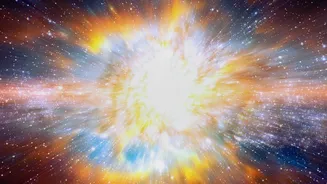
What 17th-century observers witnessed was not the birth of a star, but its spectacular death. Today, scientists have classified SN 1604 as a Type Ia supernova. This type of explosion happens in a binary star system, where two stars orbit each other. One of the stars is a white dwarf—the super-dense remnant of a star like our Sun. This white dwarf pulls material from its companion star until it reaches a critical mass, triggering a runaway thermonuclear explosion that obliterates it. These explosions are incredibly important in modern astronomy. Because they always happen at roughly the same mass, they release a consistent amount of light, making them 'standard candles' that astronomers use to measure vast distances across the universe and even track its expansion.
What Remains of Kepler's Star
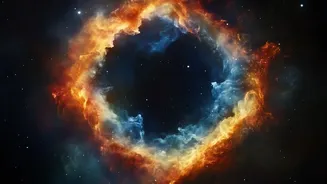
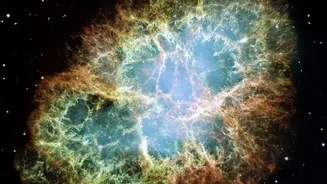
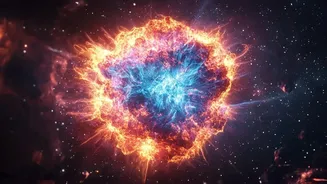
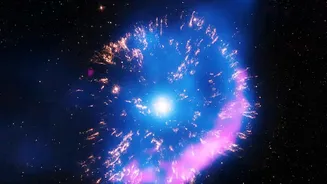
SN 1604 remains the last supernova unquestionably seen with the naked eye within our own Milky Way galaxy. The light from that explosion reached Earth over four centuries ago, but the story isn't over. Using modern instruments like NASA's Chandra X-ray Observatory and the Hubble Space Telescope, astronomers can study its aftermath: a beautiful, expanding cloud of gas and dust known as Kepler's Supernova Remnant. This shell of material, now about 14 light-years wide, is still blasting outwards at speeds up to 23 million miles per hour. By studying the chemical composition and structure of this remnant, scientists continue to piece together the final moments of the star system's life, gaining insights that Kepler could only have dreamed of.