






A New Cosmic Cartographer
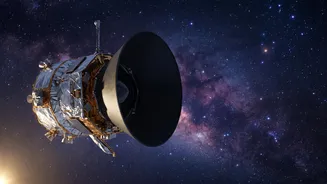
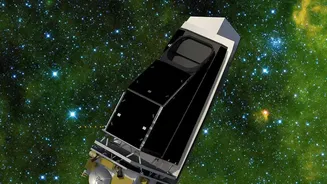
SPHEREx, short for Spectro-Photometer for the History of the Universe, Epoch of Reionization, and Ices Explorer, is a space observatory on a two-year mission to survey the entire sky. Unlike telescopes like Hubble or Webb that focus on small patches of sky in
great detail, SPHEREx is a wide-angle surveyor. Its job is to map everything. Over its mission, it will scan the whole sky four times, gathering data on hundreds of millions of galaxies and over 100 million stars in our own Milky Way. This ambitious project is managed by NASA's Jet Propulsion Laboratory with partners at Caltech, BAE Systems, and the Korea Astronomy and Space Science Institute. The goal isn't just to take pictures, but to conduct a cosmic census that will serve as a foundational resource for astronomers for decades.
Seeing the Universe in Infrared
The key to SPHEREx's power is its ability to see the universe in near-infrared light. This spectrum, invisible to the human eye, allows scientists to peer through dense cosmic dust clouds that would otherwise obscure our view. More importantly, infrared light carries the chemical fingerprints, or spectra, of molecules. SPHEREx is a spectrophotometer, meaning it measures the intensity of light at different wavelengths. By breaking down the light from every point in the sky into 102 different color bands, it can identify the chemical composition of stars, galaxies, and the spaces in between. This technique turns a simple map into a detailed chemical inventory of the cosmos, revealing what celestial objects are made of.
Answering Three Great Cosmic Questions
The SPHEREx mission is designed to tackle three major scientific quests. First, it will study the very beginning of the universe by looking for evidence of cosmic inflation—the theory that the universe expanded exponentially in the first fraction of a second after the Big Bang. By mapping the large-scale structure of galaxies, scientists can look for patterns that were seeded by quantum fluctuations during this inflationary period. Second, SPHEREx will trace the history of galaxy formation by studying the collective glow of all galaxies, known as the extragalactic background light. This will help explain how galaxies like our own Milky Way came to be. Finally, the mission will search for the ingredients for life by surveying our galaxy for water and organic molecules frozen as ice in stellar nurseries and planet-forming disks.
A Galactic GPS of Chemical Fingerprints
Think of SPHEREx as creating a 'GPS' for the universe, but one where every coordinate comes with a detailed chemical analysis. While other telescopes provide high-resolution images of specific locations, SPHEREx provides a comprehensive map of the whole sky. It does this using a simple, robust design with no moving parts in its instrument, making it highly efficient. This all-sky spectral survey will produce a massive public data archive. Scientists can use this database to identify the most interesting targets for more detailed follow-up studies by powerful observatories like the James Webb Space Telescope. By cataloging the chemical makeup of 450 million galaxies, SPHEREx is providing the context needed to understand the individual objects that other telescopes study.
Legacy of a Cosmic Surveyor
The SPHEREx mission, which launched in early 2025, is now actively collecting data. Its two-year primary mission is set to produce four complete sky maps. The resulting data set is expected to fuel astronomical discoveries for many years, similar to how previous all-sky surveys like IRAS and COBE became invaluable resources for the scientific community. By providing the first-ever all-sky near-infrared spectral survey, SPHEREx fills a critical gap in our understanding of the cosmos. It bridges the gap between the big-picture maps of the early universe and the detailed snapshots of individual stars and galaxies, weaving them together into a single, cohesive story of cosmic evolution. The information it gathers will not only help answer questions about where the universe came from but also about the prevalence of the ingredients necessary for life.