




The Cosmic Speed Limit
To understand this mind-bending reality, we first need to talk about speed. In the vast emptiness of space, there is a universal speed limit, and only one thing can travel at it: light. Photons, the particles of light, travel at an astonishing 299,792
kilometres per second. It’s so fast that a beam of light could circle the Earth more than seven times in a single second. But space is, to put it mildly, enormous. The distances between stars are so great that even at this incredible speed, light takes a significant amount of time to travel. To measure these cosmic distances, astronomers don't use kilometres. They use the light-year: the distance light travels in one year. That’s roughly 9.46 trillion kilometres. When we say a star is 10 light-years away, it means the light we see from it tonight began its journey a decade ago.
Postcards From A Distant Past
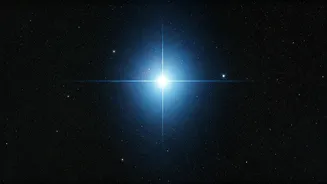
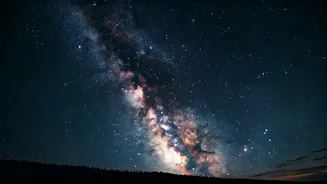
This turns the night sky into a living museum. Each star is a historical artefact, and its light is a postcard from a different era. Take Sirius, the brightest star in our night sky, often called the 'Dog Star'. It’s about 8.6 light-years away. The light you see from Sirius tonight left the star around the time the latest iPhone was being launched. It's a relatively recent message. Now, let’s look at a more distant neighbour. Polaris, the North Star, is approximately 433 light-years away. The faint light from Polaris that reaches your eyes tonight started its journey around the year 1591. While that light was travelling, the Taj Mahal was being conceived and built in Agra. You are, quite literally, seeing light from the Mughal era. Go further to a star like Betelgeuse, the reddish giant in the Orion constellation, which is about 640 light-years away. Its light began its trip around the 14th century, a time when the Tughlaq dynasty ruled the Delhi Sultanate. Every star tells a story not just of its own life, but of Earth’s history, too.
A Galactic Time Capsule
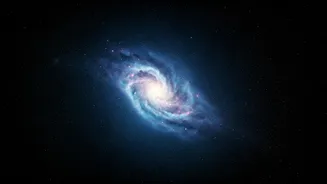
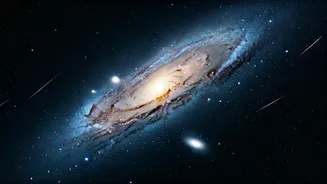
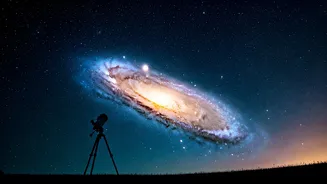
The principle scales up dramatically when we look beyond our own galaxy, the Milky Way. The nearest major galaxy to us is the Andromeda Galaxy. On a clear, dark night, far from city lights, you can spot it as a faint, fuzzy smudge in the sky. That smudge is 2.5 million light-years away. Let that number sink in. The light creating that smudge has been travelling for two and a half million years. When it began its journey, modern humans did not exist. Our earliest ancestors, of the genus *Homo*, were just beginning to walk the Earth. Looking at the Andromeda Galaxy is like peering into a deep, prehistoric past. We see Andromeda not as it is today, but as it was when primitive stone tools were the height of technology on our planet. For all we know, in the 2.5 million years it took for its light to reach us, entire star systems within it could have been born and died.
Telescopes As Time Machines
This is not just a poetic curiosity; it is a fundamental tool of modern astronomy. Powerful observatories like the Hubble Space Telescope and the James Webb Space Telescope are designed to be time machines. By capturing faint light from the most distant objects, they are looking deeper and deeper into the past. Astronomers use these telescopes to see galaxies as they were forming just a few hundred million years after the Big Bang. They are studying the “cosmic dawn,” the era when the very first stars ignited and filled the universe with light. They are not guessing what the early universe looked like; they are observing it directly, thanks to the finite speed of light. Every image of a distant galaxy is a snapshot of cosmic history, allowing us to piece together the 13.8-billion-year story of our universe.