






The Cosmic Race Against Time
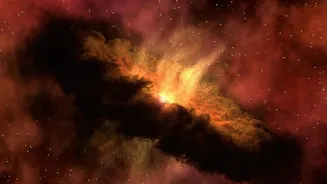
Planets are born from protoplanetary disks, which are vast, spinning platters of gas and dust that surround infant stars. For a planet to form, especially a gas giant like Jupiter, it's a race against the clock. These disks are not permanent fixtures;
they are actively being depleted by stellar winds and radiation that blow the raw materials away. The lifespan of a disk sets the fundamental timeline for planet formation—once the gas is gone, the window of opportunity to build massive planets slams shut. For most Sun-like stars, this process was thought to be relatively short, lasting only a few million years. Understanding this timeline is crucial to figuring out how planetary systems, including our own, came into existence.
Webb’s Unprecedented View
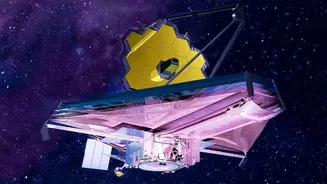
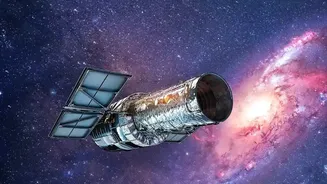
The James Webb Space Telescope is a game-changer because its powerful Mid-Infrared Instrument (MIRI) can peer through the dust that obscures these planet-forming regions. It can detect the unique chemical fingerprints of different molecules, providing a detailed inventory of the ingredients available for building new worlds. Recent studies using JWST have analysed dozens of young, Sun-like stars, creating one of the largest surveys of protoplanetary disks to date. These observations are revealing that the processes driving the dispersal of these disks evolve as the star system matures. In the youngest systems, powerful magnetic jets and winds push material away, while in older systems, other mechanisms take over.
Surprising Chemical Cocktails
Some of Webb's most exciting discoveries involve the diverse chemistry within these disks. In one disk around a very-low-mass star, scientists found an abundance of carbon-bearing molecules like ethane and benzene, but a surprising lack of oxygen-based ones. This suggests the chemical environment can be far more varied than previously thought, which would directly influence the composition of any planets that form there. In other systems, Webb has detected crucial molecules like the methyl cation (CH3+), a cornerstone of organic chemistry that helps build more complex, life-sustaining compounds. The presence of such molecules, even in environments blasted by intense radiation, helps explain how the building blocks of life can emerge in hostile cosmic settings.
A Longer Childhood for Some Planets
Recent findings have also challenged assumptions about how long these planetary nurseries can last. One study found a protoplanetary disk around a small star that has survived for about 30 million years—three times longer than typical models would predict. This discovery suggests that for smaller, less massive stars, the planet-forming period can be significantly extended. These long-lived disks provide a much bigger window for planets to form and grow, which has significant implications for where we might search for habitable worlds. It forces a rethink of planet formation models, particularly for systems that are different from our own, such as those in the early Universe or around common red dwarf stars.