



Beyond the Visible
For centuries, our understanding of the cosmos came from what we could see. Telescopes gathered light—photons—to paint pictures of distant galaxies and nebulae. But the universe's most dramatic events, like supernovae or the jets of matter fired from black
holes, are more complex. They don't just release light; they unleash a torrent of other cosmic messengers, including high-energy particles. Two of the most important are cosmic rays (charged particles like protons) and neutrinos. While light can be blocked by cosmic dust and cosmic rays are bent by magnetic fields, neutrinos are different. They are incredibly light, have no electric charge, and barely interact with anything. This makes them perfect messengers, as they travel in a straight line from their source directly to us, carrying secrets from the heart of cosmic cataclysms.
Catching a Cosmic Ghost
How do you catch a particle so elusive that trillions pass through you every second without a trace? You build a very, very big trap. Enter the IceCube Neutrino Observatory, a bizarre telescope unlike any other on Earth. Instead of mirrors, it uses a cubic kilometre of ultra-pure Antarctic ice, located deep beneath the South Pole. More than 5,000 light sensors, called digital optical modules, are suspended on long strings within this massive block of ice. On the rare occasion a high-energy neutrino strikes an atom in the ice, it creates a secondary particle that travels faster than light does in ice. This produces a faint cone of blue light, known as Cherenkov radiation. The sensors detect this flash, and by mapping the pattern and timing of the light, scientists can reconstruct the neutrino's energy and the direction it came from with incredible precision.
A Global Fire Alarm
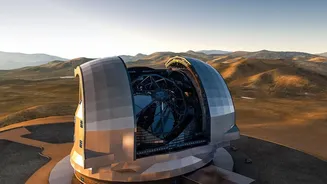
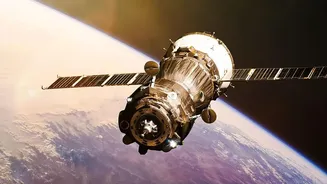
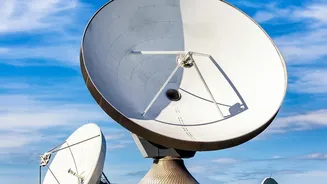
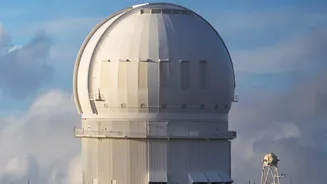
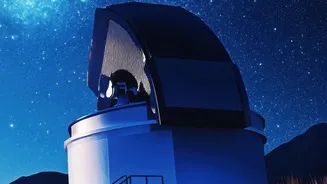
Detecting a single high-energy neutrino is a monumental achievement, but it's only half the story. This is where 'multi-messenger astronomy' comes into play. When IceCube detects a promising neutrino, its systems automatically send an alert to observatories around the globe in less than a minute. This acts like a cosmic fire alarm, telling gamma-ray, X-ray, optical, and radio telescopes exactly where in the sky to look. Dozens of instruments, both on the ground and in orbit, can then pivot to search for a corresponding flash of light—the afterglow of the explosive event that launched the neutrino billions of years ago. This rapid coordination is crucial because the light from these events can be fleeting, and without the neutrino's tip-off, we might miss it entirely.
Solving a Cosmic Mystery
This technique has already yielded incredible results. In 2017, IceCube detected a high-energy neutrino and sent out an alert. Telescopes that followed up found a 'blazar'—a giant galaxy with a supermassive black hole at its centre, firing a jet of particles directly at Earth—in a state of flare. This object, known as TXS 0506+056, was located 5.7 billion light-years away. For the first time, scientists had pinpointed a specific source of high-energy cosmic neutrinos, confirming that these blazars are powerful particle accelerators. By combining the neutrino data with information from across the electromagnetic spectrum, astronomers could build a complete picture of the physics driving the blazar's jet. This single event was a breakthrough, marking the true arrival of multi-messenger astronomy and providing a smoking gun for where some of the universe's most energetic particles are born.