





A Glimpse into Cosmic Dawn
Imagine pointing a powerful telescope at a patch of sky that appears completely empty. You leave the shutter open for over a week, collecting the faintest trickles of light. This was the audacious idea behind the Hubble Deep Field. In 1995, astronomers
did just that, dedicating ten consecutive days of telescope time to a tiny, dark sliver of the constellation Ursa Major. The result was revolutionary. The image was not empty; it was filled with nearly 3,000 objects. And these weren't stars—they were entire galaxies, some of the youngest and most distant ever seen. Because light takes time to travel, looking at these distant galaxies is like looking back in time. The Deep Field images show us galaxies as they were billions of years ago, providing a fossil record of cosmic evolution and allowing astronomers to witness the era when galaxies were just beginning to form.
The Universe in Bursts
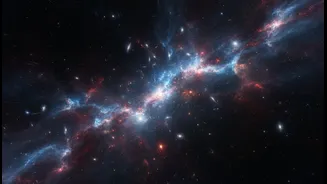
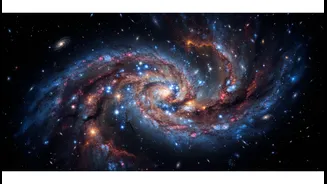
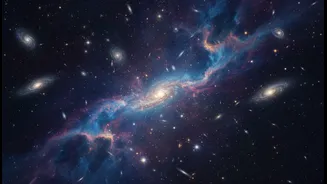
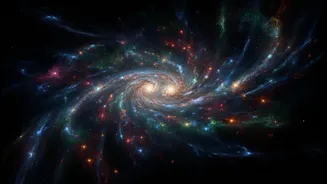
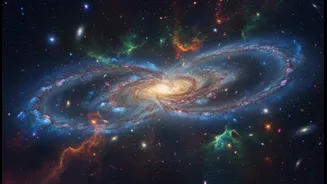
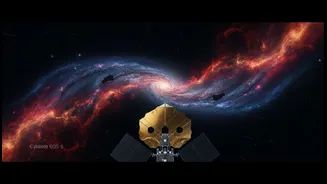
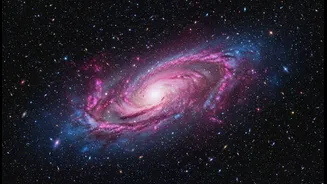
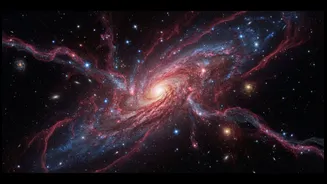
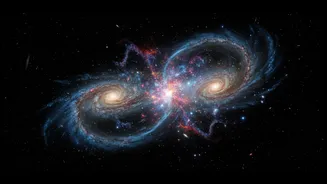
Among the most fascinating objects in the early universe are 'starburst' galaxies. While our own Milky Way galaxy has a steady, almost placid rate of star formation, producing a few new stars per year, starburst galaxies are cosmic factories in overdrive. They experience intense, furious periods of star formation, churning out stars at rates tens or even hundreds of times greater than normal galaxies. This frenzy, however, is short-lived. A starburst phase might last for ten million years or so—a mere blink of an eye in a galaxy's multi-billion-year lifespan. Scientists believe these bursts are often triggered by galactic collisions or close encounters, which were much more common in the crowded early universe. The gravitational chaos from these interactions sends shockwaves through clouds of gas, causing them to collapse and ignite into a chain reaction of star birth.
Uncovering a Cosmic Rhythm
By studying thousands of distant galaxies in the Hubble Deep and Ultra Deep Fields, astronomers can piece together the life story of a typical galaxy. The data suggests that these starburst periods are not a one-time event, but a cyclical process. A galaxy undergoes a massive burst of star formation, rapidly using up its available gas and dust. The most massive of these new stars live fast and die young, exploding as supernovae. These explosions, along with powerful stellar winds, can blow the remaining gas out of the galaxy, temporarily shutting down star formation. The galaxy then enters a quiet phase. Over millions of years, this gas may cool and fall back into the galaxy, or the galaxy might attract new gas from its surroundings, setting the stage for the next starburst cycle. This rhythm of boom and bust appears to be a fundamental process in how galaxies grow and evolve.
From Distant Past to Our Future
Studying these ancient starbursts is not just an academic exercise in cosmic history; it helps us understand our own galactic home. Recent studies using Hubble data indicate that in the first few billion years after the Big Bang, starburst galaxies were not rare exceptions but a major force, producing a significant percentage of all new stars. The discoveries made with the Deep Fields have fundamentally changed our understanding of galaxy evolution. They showed that galaxies formed much earlier than previously thought and that they were smaller and more irregular in the past. By observing these cycles of creation in the distant past, we gain crucial insights into the forces that built the large, structured galaxies we see today, including our own Milky Way. Every star in our sky is a descendant of these early, chaotic processes, a reminder that we are intrinsically linked to the universe's most distant past.