




The Ultimate Time Machine
We often talk about stars being 'light-years away', but it’s easy to misunderstand this as a measure of time. A light-year is actually a measure of distance: the distance light travels in one year. And light is the fastest thing in the universe, zipping
along at nearly 3,00,000 kilometres per second. Yet, space is so incomprehensibly vast that even at this breakneck speed, the light from our celestial neighbours takes years, centuries, or even millennia to reach our eyes. This means that when you look at a star, you are seeing it as it was in the past. The night sky is not a snapshot of the present; it is a collage of different historical moments, all arriving on your retina at the same time. Stargazing is, in the most literal sense, a form of time travel.
Greetings from the Recent Past
Let’s start with a familiar sight. Sirius, known as 'Vyaadh' in India, is the brightest star in our night sky. It's relatively close, at about 8.6 light-years away. This means the light you see from Sirius tonight began its journey in late 2015. While that may not sound ancient, think about everything that has happened in the world since then. Now, consider Vega, another bright star visible from India, which is 25 light-years away. The light we see from it tonight left the star around 1999, the year of the Kargil War. Every star tells a story, not just of its own life, but of our own history. The light arriving now is a silent witness to the world it departed from.
Echoes of Empires
As we look at more distant stars, we travel further back in time. Polaris, the North Star or 'Dhruva Tara', is approximately 433 light-years away. The light gracing our sky tonight from Polaris left the star around the year 1591. At that time in India, the Mughal Empire was flourishing under Emperor Akbar. Shakespeare was writing his first plays in England. The photons that left Polaris then have been travelling through space for over four centuries, finally ending their journey in your eye. Consider Betelgeuse, the giant red star in the Orion constellation, known in Indian astronomy as 'Thiruvathirai'. It’s about 640 light-years distant. The light we see from it left around the year 1384, during the era of the Delhi Sultanate. You are literally seeing medieval light.
A Message Older Than Humanity
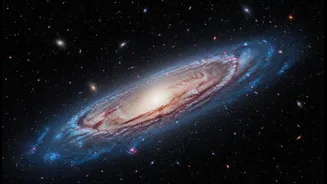
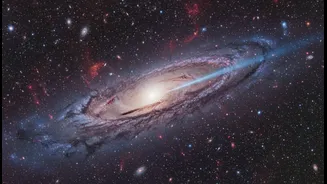
The scale becomes truly mind-bending when we look beyond our own galaxy. On a clear, dark night, far from city lights, you might be able to spot a faint, fuzzy patch in the sky. This is the Andromeda Galaxy, our closest major galactic neighbour. That smudge of light is 2.5 million light-years away. The light you are seeing is 2.5 million years old. When that light began its cosmic voyage, modern humans (Homo sapiens) did not yet exist. Our early hominid ancestors, like Homo habilis, were just beginning to use stone tools in Africa. The entire story of human civilisation—from the first cave paintings to the smartphone in your pocket—has unfolded while that ancient light was silently speeding across the intergalactic void. To look at Andromeda is to see a relic from a time before humanity itself.
When the Present Erases the Past
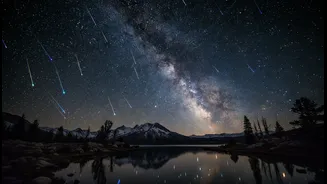
This is where the 'sky glare' from the headline becomes a modern tragedy. After travelling for centuries, millennia, or even millions of years, this ancient light arrives at Earth, only to be washed out in the final fraction of a second of its journey. Light pollution from our cities, streetlights, and buildings scatters in the atmosphere, creating an orange-hued dome that obscures all but the brightest stars. For a growing number of people in urban India, the Milky Way is something seen only in pictures. We are becoming disconnected from this profound cosmic history. By brightening our nights on the ground, we are dimming our view of the past and losing a fundamental connection to the universe.