


The Black Hole Family Problem
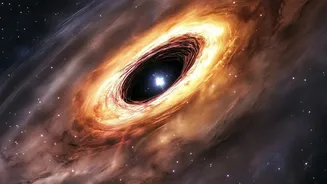
In the universe's catalogue of curiosities, black holes come in two well-established sizes: small and extra-large. First, there are stellar-mass black holes, typically weighing between five and a few dozen times the mass of our sun. These are the common
variety, formed when a single massive star runs out of fuel and collapses under its own gravity. Then, on the other extreme, you have the titans: supermassive black holes. These behemoths, millions or even billions of times our sun's mass, lurk in the centre of nearly every large galaxy, including our own Milky Way. For a long time, this was the entire family photo. The immense gulf between these two categories created a glaring question for astrophysicists: where were the 'middle children'? This absence of black holes between roughly 100 and 100,000 solar masses was a profound mystery. It seemed illogical that nature would produce black holes in only small and super-large sizes, leaving nothing in between.
Meet the Cosmic Middleweight
Scientists dubbed this theoretical, missing class "intermediate-mass black holes," or IMBHs. The problem wasn't just that they seemed to be missing; it was that their existence is crucial for explaining the cosmos as we see it. The leading theory for how supermassive black holes get so big, so fast, is that they grew from smaller 'seeds'. One plausible seed is an IMBH, which could form in a dense cluster of stars and then sink to the galactic centre, merging and growing over cosmic time. Without IMBHs, explaining how a supermassive black hole could appear in the early universe is incredibly difficult, as it would require near-impossible growth rates from a smaller stellar-mass black hole. Finding IMBHs would provide the 'missing link' in black hole evolution, confirming the theory of hierarchical growth where smaller objects merge to create larger ones. But they remained frustratingly elusive for decades, with only indirect and debated candidates.
Hearing the Universe Shake
The breakthrough came not from seeing, but from listening. The Laser Interferometer Gravitational-Wave Observatory (LIGO) and its international partners, Virgo and KAGRA, are designed to detect the infinitesimal ripples in spacetime itself, known as gravitational waves. These waves are unleashed by the most violent events in the cosmos, including the collision of two black holes. In 2019, the observatories registered a signal dubbed GW190521. It was the result of two black holes—one about 85 and the other 66 times the sun's mass—spiralling into each other and merging. The collision produced a new black hole with a mass of about 142 suns, with the remaining energy blasted out as gravitational waves. This was a landmark moment: the resulting 142-solar-mass object was the first definitive, unambiguous detection of an intermediate-mass black hole. Since then, re-analysis of detector data has revealed more candidates, strengthening the evidence that these objects are out there.
Solving the Supermassive Puzzle
The detection of GW190521 and other subsequent IMBH merger candidates provides the first concrete, observational evidence supporting the theory that supermassive black holes are built from the bottom up. It proves that black holes can and do exist in this intermediate mass range. It also demonstrates a key mechanism for their growth: mergers. Seeing two smaller black holes combine to form a larger one in the IMBH class is like witnessing the fundamental construction process in action. This hierarchical merger model—where stars collapse into black holes, which then merge to form IMBHs, which in turn can merge to form even larger ones—is now on much firmer ground. These gravitational wave detections are like fossils, allowing scientists to piece together the life cycle of black holes. Each merger offers a snapshot of a process that, over billions of years, could build the galactic giants we see today.