



The Illusion We All Share
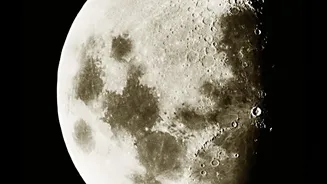
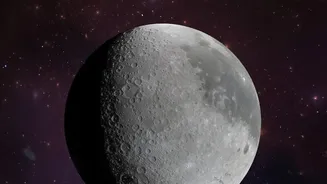
This powerful and ancient trick of the mind is called the Moon illusion, and it has perplexed thinkers for thousands of years, from Aristotle to modern-day scientists. It doesn't just apply to the Moon, either. The Sun and even constellations of stars
appear much larger when they are near the horizon compared to when they are high overhead. The fascinating part is that this is purely a psychological effect. If you were to take a photograph of the low-hanging Moon and then another hours later when it’s at its zenith, the two images of the Moon would be virtually the same size. You can even prove it to yourself: next time you see a giant-looking Moon, hold out your pinky finger at arm's length. You’ll find that your fingernail can easily cover it, just as it would when the Moon is high in the sky. The change isn't in the sky; it's in how our brains are interpreting the view.
No, It's Not the Atmosphere
A common folk explanation is that Earth’s atmosphere acts like a magnifying glass for the rising Moon. While the atmosphere does affect the color of the Moon, often making it appear more yellow or orange by scattering blue light, it doesn't magnify it. In fact, atmospheric refraction slightly squashes the image of the Moon, making it a tiny bit smaller vertically when it's on the horizon. So, we can rule out the atmosphere as the culprit. The answer lies somewhere far more complex and interesting: within the circuits of our own brains.
Meet the Ponzo Illusion
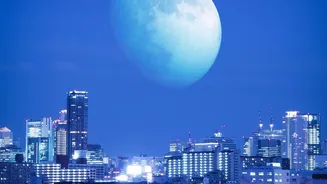
One of the most compelling explanations for the Moon illusion is a classic psychological trick called the Ponzo illusion. Imagine two parallel lines, like railroad tracks, converging into the distance. If you draw two identical horizontal bars across the tracks, one 'near' you and one 'farther away' where the tracks appear closer together, the 'farther' bar will look significantly larger. Your brain, which is hardwired to understand perspective, assumes that if two objects have the same retinal size but one appears farther away, the farther object must be physically bigger. When the Moon is on the horizon, it’s surrounded by trees, buildings, and mountains—depth cues that our brain uses to establish a sense of great distance. So, our brain 'enlarges' the Moon to compensate, thinking 'if that object is that far away and still looks this big, it must be enormous!'
The Flattened Sky Dome
Another, closely related theory is the 'apparent distance hypothesis', or the 'flattened sky' theory. Most of us don't perceive the sky as a perfect hemisphere above us. Instead, we see it as a flattened bowl. The horizon feels much, much farther away than the point directly overhead, which can feel quite close, especially if there are clouds. Our brain applies the same logic as the Ponzo illusion: if the Moon at the 'distant' horizon and the Moon at the 'close' zenith project the same size image on our retina, our brain concludes the horizon Moon must be physically larger. Interestingly, this explanation has been around since at least the 2nd century, but it remains a cornerstone of how scientists understand the illusion today.
It's All About Context
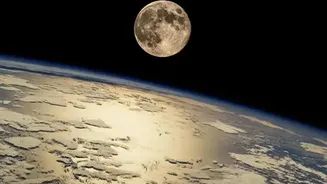
Ultimately,the Moon illusion is a story about context. Whenthe Moon hangs high inthe vast , empty expanse of thenight sky , your brain has no reference points . It's just a bright object in a black void , and it appears smaller . But whenit’s framed by a familiar landscape , your brain’s sophisticated—and usually very helpful—depth perception and size constancy systems get tricked . They are so committed to creating a coherent 3D model ofthe world that they will literally changethe size of what you perceive to makethe scene logical . Astronautsin orbit , who have no foreground objects to compare with , have also reported seeingthe Moon illusion , suggesting there may be even more to this puzzle . But for those of us onthe ground , it’sthe comparison that creates themagic .