
A Storm Under Watch
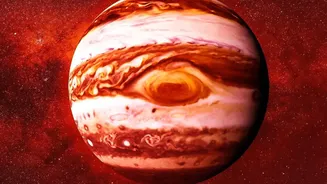
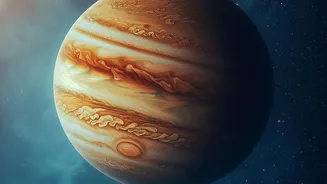
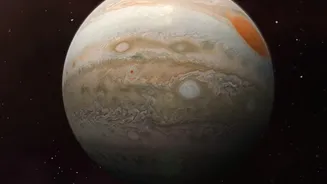
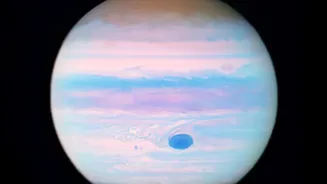
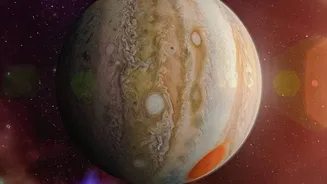
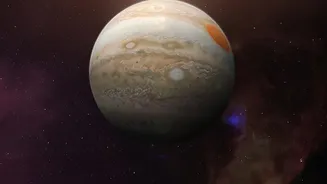
Jupiter’s most famous feature, the Great Red Spot, is an enormous anticyclonic storm that has captivated astronomers since it was first consistently observed in the 19th century. This swirling crimson oval is so vast that it could comfortably swallow
our entire planet. For years, scientists have noted a consistent trend: the Great Red Spot is shrinking. What was once a large oval is steadily becoming more circular, its total area diminishing decade by decade. This long-term decline has raised questions about the storm's ultimate fate, with some studies suggesting it could vanish within our lifetimes. Now, new detailed observations are adding another layer of complexity to this story, focusing not just on the spot itself, but on the smaller storms that dance within and around it.
The 'Cosmic Tornados' in Question
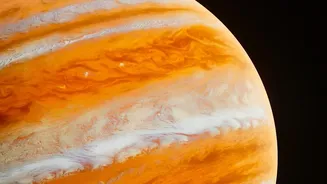
The term “cosmic tornados” paints a dramatic picture, but in scientific terms, these features are smaller vortices or eddies. Think of them not as separate twisters, but as complex currents and smaller rotating systems within the colossal weather pattern of the Great Red Spot. Recent observations, particularly from the Hubble Space Telescope's Outer Planet Atmospheres Legacy (OPAL) program, have provided an unprecedented look at this atmospheric activity. These studies reveal that very small eddies are feeding into the main storm, a process scientists hypothesise could be responsible for altering its internal dynamics and energy. This interaction is key, as these smaller systems can either feed momentum into the Great Red Spot, sustaining it, or sap its energy, potentially accelerating its decay.
What the New Images Reveal
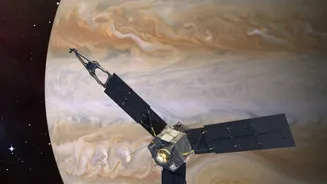
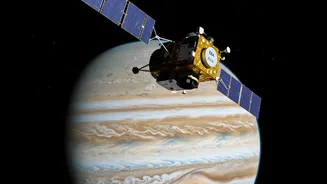
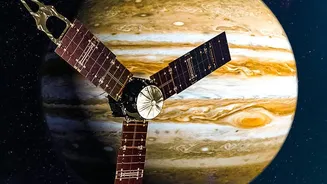
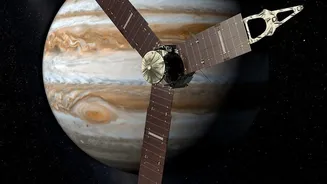
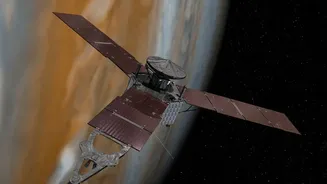
Recent analyses, including data gathered over 90-day periods, have shown that the Great Red Spot is far from stable. It appears to wobble and fluctuate in size, jiggling like gelatin while its rotational speed varies. This was an unexpected discovery for astronomers, who are now trying to understand the hydrodynamics behind this behaviour. The headline's “shrinking cosmic tornados” refers to the changes observed in these smaller, interacting vortices. While the Great Red Spot itself is shrinking long-term, the behaviour of these smaller eddies—how they form, spin, and are consumed by the larger storm—provides crucial, real-time clues about the mechanics of the storm's slow transformation. These detailed views are made possible by powerful instruments like the Hubble Space Telescope and NASA's Juno spacecraft, which has been orbiting Jupiter since 2016.
Why Does This Matter?
Studying the weather on Jupiter is about more than just satisfying curiosity about a distant planet. Jupiter’s atmosphere is a massive natural laboratory for fluid dynamics. Understanding the forces at play in a storm that has lasted for at least 190 years gives scientists invaluable insight into planetary atmospheres in general. The principles governing the Great Red Spot and its surrounding vortices can help refine meteorological models for Earth's own hurricanes and cyclones. Furthermore, as we discover more exoplanets orbiting other stars, Jupiter serves as a vital archetype for gas giants across the galaxy. Learning how its storms evolve and eventually dissipate provides a framework for understanding the climates of these far-off worlds. Every new detail, from a slight wobble to a change in a small eddy, helps complete a much larger cosmic puzzle.