





A Mission to a Water World
Launched in October 2024, the Europa Clipper is the largest interplanetary spacecraft NASA has ever built. Spanning the length of a basketball court with its solar arrays deployed, the probe is on a multi-year journey to the Jupiter system, scheduled
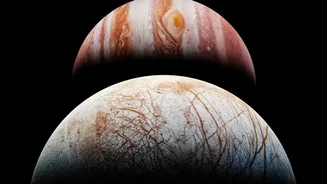
to arrive in April 2030. Its target, Europa, is one of Jupiter's large moons and a place of immense scientific interest. Strong evidence suggests that beneath its thick, frozen crust lies a global ocean of liquid saltwater that may contain more than twice the amount of water as all of Earth's oceans combined. Europa Clipper’s objective is not to find life itself, but to determine if this hidden ocean has the right conditions to support it.
Why Europa Is a Prime Suspect
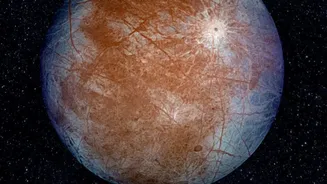
For decades, scientists have considered Europa one of the most compelling places to search for habitable environments. Evidence for its subsurface ocean comes from multiple sources. Data from the Galileo spacecraft in the 1990s revealed disruptions in Jupiter's magnetic field around Europa, suggesting the presence of a conductive material, like a salty ocean. The moon's fractured, relatively young surface, which has few impact craters, also hints at geological activity and a dynamic interior, possibly driven by a liquid layer below. This activity is likely powered by tidal heating—the constant stretching and flexing of the moon caused by Jupiter's immense gravity—which could provide enough energy to keep the ocean from freezing solid.
The Hunt for Habitability Markers
The mission is focused on finding "habitability markers," not aliens. These are the three fundamental ingredients required for life as we know it: liquid water, essential chemical elements, and a source of energy. Europa Clipper will investigate all three. The mission's main goals are to confirm the ocean's existence, measure its depth and salinity, and determine the thickness of the ice shell above it. It will also analyze the moon's composition, searching for organic compounds and other key chemicals like carbon, hydrogen, nitrogen, oxygen, phosphorus, and sulfur. Finally, it will study the geology to understand the energy available within the system.
A Toolkit for an Icy Moon
To achieve its goals, Europa Clipper is equipped with a suite of nine advanced science instruments, protected within a radiation-shielded vault to withstand Jupiter's harsh environment. The REASON instrument, an ice-penetrating radar, will probe the icy shell to find the ocean and identify pockets of water closer to the surface. Spectrometers like MISE and Europa-UVS will map the surface composition, identifying ices, salts, and organic materials. A magnetometer will measure the magnetic field to confirm the ocean's depth and saltiness, while a thermal imager, E-THEMIS, will scan for warm spots where water may be erupting from below as plumes. Other instruments will analyze any gases or dust particles ejected from the surface, offering a direct taste of Europa's chemistry.
A Long Journey and a Complex Dance
The probe's 2.9-billion-kilometre journey is not a straight shot. To build up speed, it will perform gravity-assist flybys of Mars in 2025 and Earth in 2026. Upon arriving at Jupiter in 2030, it won't orbit Europa directly due to the planet's intense radiation. Instead, it will enter a long, looping orbit around Jupiter and perform nearly 50 close flybys of Europa over four years, some as low as 25 kilometres above the surface. This intricate orbital dance allows the spacecraft to gather detailed data from different regions of the moon while limiting its exposure to damaging radiation, extending the life of the mission and its sensitive electronics.