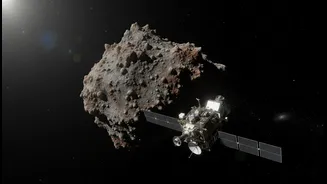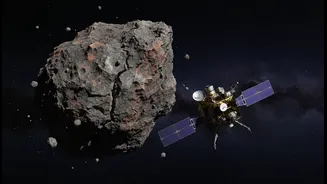




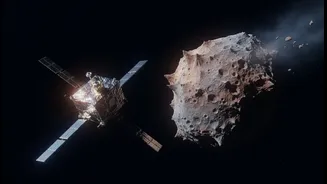


A New Chapter for a Veteran Explorer
Japan's Hayabusa2 probe is a celebrated veteran of space exploration. After launching in 2014, it successfully rendezvoused with the asteroid Ryugu, collected subsurface samples, and returned them to Earth in December 2020. But with about half of its
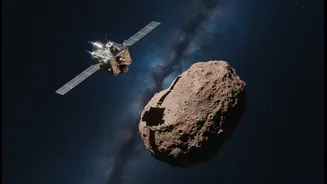
xenon fuel remaining, the Japan Aerospace Exploration Agency (JAXA) repurposed the hardy spacecraft for an ambitious extended mission, nicknamed Hayabusa2♯ (pronounced 'sharp'). This new multi-year journey involves two key asteroid encounters. The first was a high-speed flyby of the asteroid (98943) Torifune, which occurred in July 2026. The ultimate destination is a rendezvous with a tiny, rapidly spinning asteroid named 1998 KY26, scheduled for July 2031. This extended mission pushes the spacecraft, originally designed for a six-year mission, into a nearly two-decade-long odyssey, testing its long-term durability.
The Challenge of Precision Navigation
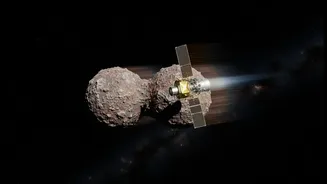
The July 2026 flyby of Torifune was a masterclass in deep-space navigation. Unlike a planned rendezvous, a high-speed flyby requires extreme precision to gather meaningful data without colliding with the target. The probe travelled at roughly 18,000 kilometers per hour relative to the asteroid. Because asteroids are small and dark, they can often only be spotted by the spacecraft's own cameras a few days before the encounter. This forces mission controllers to make last-minute trajectory adjustments, a nerve-wracking process when a signal from the spacecraft can take many minutes to reach Earth. The successful navigation past Torifune served as a vital technology demonstration, honing the skills needed to approach and interact with small, fast-moving objects in deep space. This capability is fundamental for future, more complex missions, whether for scientific research or planetary defense.
Unlocking New Asteroid Science
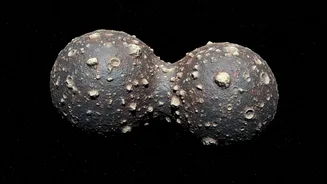
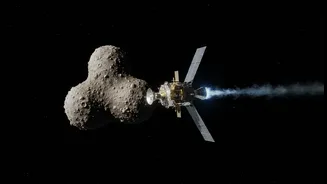
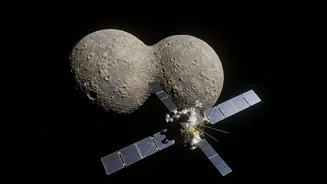
The extended mission provides a valuable opportunity to study two very different types of asteroids, expanding on the knowledge gained from Ryugu. Torifune, an elongated, two-lobed asteroid roughly 450 meters wide, gave scientists their first close-up look at what could be a rare type of space rock. The ultimate target, 1998 KY26, is even more scientifically intriguing. It is an incredibly small object, with recent estimates putting its diameter at just 14 meters, and it rotates at an astonishingly fast pace. No spacecraft has ever visited an asteroid this small. Studying it in 2031 will provide unprecedented insights into the physical properties and composition of the most common type of objects in near-Earth space. These tiny bodies could be single solid rocks or loose collections of rubble, and understanding their structure is key to deciphering how larger bodies like Ryugu and Bennu formed.
A Rehearsal for Planetary Defence
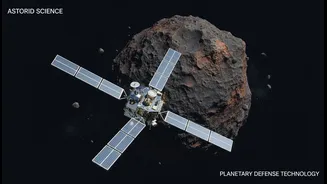
Perhaps the most critical aspect of Hayabusa2's extended mission is its contribution to planetary defense. Asteroids the size of 1998 KY26 are comparable to the object that exploded over Chelyabinsk, Russia in 2013, and are estimated to hit Earth every 100 to 1,000 years. While they are too small to cause a global catastrophe, they can create significant regional damage. They are also notoriously difficult to detect with ground-based telescopes. By flying past Torifune and planning a rendezvous with 1998 KY26, JAXA is essentially conducting a dress rehearsal for a real-life threat scenario. The mission tests our ability to quickly intercept and characterize a potentially hazardous asteroid. The precision guidance technology required to perform a close flyby is directly applicable to future 'kinetic impactor' missions, where a spacecraft would be deliberately crashed into an asteroid to alter its course.