




The First Five Minutes: Stability Is Key
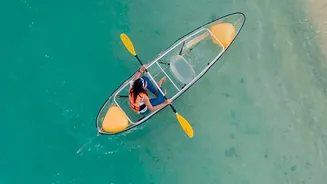
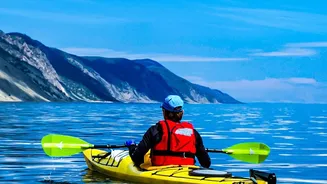
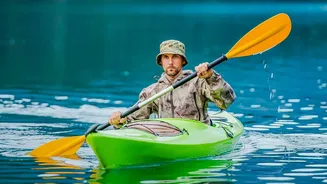
For the absolute beginner, kayaking generally offers a more stable and reassuring start. Because you are sitting low in the vessel, your center of gravity is much lower, making the craft feel incredibly steady almost immediately. Most recreational rental
kayaks are designed to be wide and forgiving, so the chances of tipping are quite low on calm water. This allows you to focus on the basics of paddling without worrying about balance. A stand-up paddleboard (SUP), on the other hand, presents an initial balance challenge. While modern rental boards are wide and built for stability, standing on a moving surface requires engaging muscles you might not be used to. Most instructors recommend starting on your knees to get a feel for the board before attempting to stand. So, if your goal is to feel secure and start moving confidently within minutes, the kayak has a clear edge.
The Learning Curve: Getting Up to Speed
Kayaking has a very gentle learning curve. The double-bladed paddle makes it intuitive to propel yourself forward in a relatively straight line, even without perfect technique. Most beginners can get the hang of basic steering and movement within a single short session. Paddleboarding requires a bit more patience. After mastering kneeling, the next step is standing, which involves finding your footing, keeping a slight bend in your knees, and looking toward the horizon, not down at your feet. Learning to use the single-bladed paddle effectively to steer also takes practice. However, once you find your balance, the learning curve flattens out considerably. The versatility of a SUP is a major advantage; you can stand, kneel, sit, or even lie down, giving you multiple ways to enjoy the water as you learn.
A Tale of Two Workouts: Core Challenge vs. Upper Body Burn
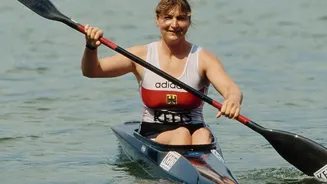
Your choice of craft will determine the type of workout you get. Stand-up paddleboarding is widely recognized as a fantastic full-body workout. The act of balancing constantly engages your core, leg, and stabilizer muscles, while every paddle stroke works your arms, back, and shoulders. It’s a low-impact exercise that can burn a significant number of calories, especially if you paddle at a brisk pace. Kayaking provides an excellent upper-body and core workout. The rotational movement of paddling engages your obliques, abs, back, and arms. While your lower body is less involved than on a paddleboard, maintaining posture and using your torso to power your strokes provides a solid workout. For those looking for a comprehensive fitness challenge, the SUP is the clear winner, but for a focused upper-body session, the kayak delivers.
The View and The Vibe: Different Perspectives
The experience on the water differs greatly between the two. On a paddleboard, your standing position gives you a superior vantage point. You can see further across the water and, more importantly, peer down into it, making it ideal for spotting fish or seeing underwater features. It offers a feeling of freedom and connection with the environment. A kayak provides a more intimate, water-level perspective. Sitting low allows you to glide quietly, getting closer to wildlife along the shoreline without causing much disturbance. The seated position is often more comfortable for longer journeys, allowing you to cover more distance with greater ease. If you plan to be on the water for several hours or want to explore a larger area, a kayak is often the more comfortable and efficient choice.
The Rental Experience: What to Expect
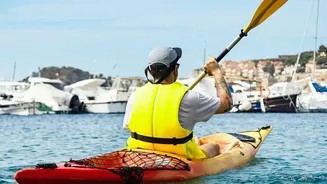
When you rent either a kayak or a paddleboard, the package is typically all-inclusive. Your rental will include the board or boat, a paddle, and a personal flotation device (PFD), which you should always wear. Most rental shops will also provide a quick orientation on safety and basic technique before you launch. Sit-on-top kayaks are the most common rental models because they are user-friendly, stable, and easy to get on and off. For paddleboards, you'll likely get a wide, sturdy board designed for beginners. Some rental outfits may offer tandem kayaks, perfect for couples or a parent and child. Costs are often comparable, with hourly and daily rates available for both.