







The Unforgiving Chill of Space
Imagine a place where the nightly temperature can drop to minus 130 degrees Celsius. This isn't a sci-fi movie; it's a typical night on Mars. For context, the coldest temperature ever recorded on Earth was around minus 89 degrees Celsius. On the Moon,
it can get even colder, with temperatures in permanently shadowed craters plunging to a staggering minus 250 degrees Celsius. For a sophisticated robot packed with sensitive electronics, computers, and batteries, such extreme cold is a mission-ending threat. Components can crack, batteries can lose their ability to hold a charge, and lubricants can freeze solid. To explore these frigid landscapes, rovers need more than just a good coat; they need a constant, reliable source of internal warmth.
The Dual-Purpose Nuclear Heart
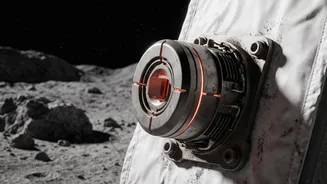
Enter the Multi-Mission Radioisotope Thermoelectric Generator, or MMRTG. It's essentially a nuclear battery that serves as both the heart and the furnace for rovers like Curiosity and Perseverance. Inside the MMRTG is a ceramic form of plutonium-238. As this isotope naturally decays, it releases a steady, predictable amount of heat. This process has nothing to do with nuclear fission, like in a power plant; it's a simple, continuous release of thermal energy. This heat is then used in two crucial ways. First, a set of solid-state devices called thermocouples convert the heat directly into electricity, providing around 110 watts to power the rover's systems and charge its batteries, day and night, regardless of dust storms or season. This constant power is a major advantage over solar-powered rovers, which can be disabled by dust or long winter nights.
A Network of Personal Heaters
The second, equally vital, function of the MMRTG is providing warmth. The excess heat generated by the decaying plutonium is captured and circulated through fluid-filled pipes. This system acts like a central heating network, keeping the rover’s core systems from freezing. This is often focused on protecting the 'Warm Electronics Box' (WEB), a heavily insulated compartment housing the rover's main computer, batteries, and other critical electronics. This ensures the rover's 'brain' stays within its operational temperature range, which is roughly between minus 40 and plus 40 degrees Celsius.
Tiny Warmers for Targeted Heat
Sometimes, a rover needs a more targeted source of heat for specific instruments or mechanical parts located away from the main body. For this, engineers use Radioisotope Heater Units, or RHUs. These are much smaller devices, about the size of a C-cell battery, each containing a tiny pellet of plutonium-238 that generates about one watt of heat. Unlike RTGs, RHUs do not produce electricity; their sole purpose is to provide a steady, low level of heat to keep a specific component from freezing. They are simple, have no moving parts, and can provide warmth for decades. Dozens of these units can be strategically placed around a rover, acting like tiny, long-lasting hand warmers for the robot's most vulnerable parts.
A System Built for Survival
The combination of a powerful MMRTG for electricity and central heating, along with strategically placed RHUs for spot-warming, creates a robust thermal management system. This nuclear-powered approach is what has enabled the long-term success of missions far from the Sun, where solar power becomes less viable. It allows rovers to operate continuously through harsh Martian winters and explore areas that would otherwise be inaccessible. While solar power and advanced batteries were used on earlier rovers like Spirit and Opportunity, the constant, reliable power and heat from radioisotope systems give modern rovers like Perseverance the endurance needed for long and ambitious science campaigns. This technology, proven over decades since the Voyager missions, remains a cornerstone of deep-space exploration.