




A Sweet Discovery Near the Galaxy's Heart
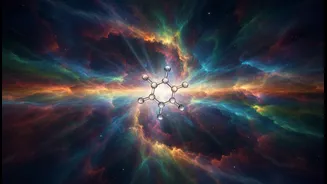
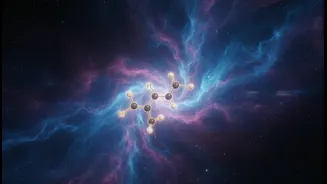
In a landmark finding, an international team of scientists has identified erythrulose, a four-carbon sugar, in a dense molecular cloud named G+0.693-0.027, located near the center of our Milky Way. Using the powerful Yebes and IRAM radio telescopes in Spain,
researchers detected the faint radio signals, or spectral fingerprints, that uniquely correspond to this specific molecule. While sugars have previously been found in meteorites that have landed on Earth, this is the first definitive detection of a true sugar molecule in the interstellar medium itself—the diffuse gas and dust that exists between star systems. On Earth, erythrulose is found in things like red raspberries and is used in some sunless tanning products.
The Building Blocks of Life
This discovery is more than just a cosmic curiosity; it's a crucial piece in the puzzle of abiogenesis, the process by which life arises from non-living matter. Sugars are fundamental to life as we know it. They not only serve as energy sources but also form the structural backbone of RNA and DNA, the molecules that carry genetic information. The presence of a relatively complex sugar like erythrulose suggests that the chemical factories of space are more capable than previously thought. It provides compelling evidence that some of life's essential ingredients can form in the cold, harsh environment of space, long before planets are even born. This supports the long-held hypothesis that comets and asteroids may have "seeded" early Earth with the prebiotic molecules necessary to kick-start life.
Challenging Old Theories
One of the most surprising aspects of the discovery is the abundance of erythrulose. Scientists found it to be at least eight times more common than similar, but simpler, three-carbon sugars, which weren't detected at all in the same cloud. This challenges a prevailing view in astrochemistry that complex molecules form incrementally, by adding one carbon atom at a time. Instead, the evidence suggests that erythrulose might be forming on the icy surfaces of interstellar dust grains from the combination of simpler two-carbon molecules. This opens up new possibilities for how other, even more complex, prebiotic molecules could be synthesized in space.
A Dose of Cosmic Reality
While the detection of interstellar sugar is exciting, it's important to understand its limitations. This discovery does not mean we've found evidence of life in space. Rather, we have found some of the raw ingredients. Erythrulose itself is not used in our genetic code, but in water, it can transform into other sugars like threose, which is considered a possible evolutionary precursor to RNA. Furthermore, detecting a molecule in a gas cloud thousands of light-years away is a monumental technical challenge, and while the evidence is strong, such findings always undergo intense scientific scrutiny. The journey from a simple sugar in a cosmic cloud to a living organism on a rocky planet involves countless complex steps that remain a deep mystery. The presence of these ingredients does not guarantee that the recipe for life will be completed.
The Search for Our Cosmic Origins Continues
The discovery of erythrulose is a significant milestone in a long and ongoing scientific endeavor. For decades, astronomers have been cataloging the growing list of molecules found in space, from simple compounds to more complex organic structures. Each new detection provides another data point, helping scientists refine their models of interstellar chemistry. This finding energizes the search for other key prebiotic molecules, particularly ribose, the five-carbon sugar that is the backbone of RNA. By understanding the inventory of chemicals available in the stellar nurseries where planets form, we can better understand the probability of life emerging elsewhere in the universe. The discovery of erythrulose shows us that the cosmos is a rich chemical laboratory, and the story of life's origins may have its earliest chapters written in the stars.