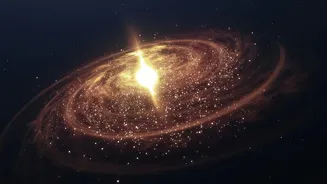


For decades, we’ve been told the universe is 13.8 billion years old. But what if that's only half the story? A new study is challenging this fundamental timeline, suggesting our cosmos could be much older, and far stranger, than we imagined.
The Universe's Official Story
Our current,
best-guess history of the universe is called the Lambda Cold Dark Matter (ΛCDM) model. It’s the story you probably learned in school: about 13.8 billion years ago, everything that exists burst forth in the Big Bang. Since then, the universe has been expanding. According to this model, the cosmos is made of three main ingredients: the normal matter we can see (about 5%), an invisible substance called 'dark matter' that provides extra gravity (about 27%), and a mysterious force called 'dark energy' that’s causing the expansion to speed up (about 68%). This model has been incredibly successful, passing a wide range of observational tests for over 25 years and forming the bedrock of modern cosmology.
Puzzles in the Cosmos
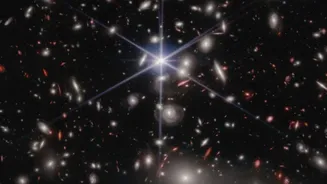
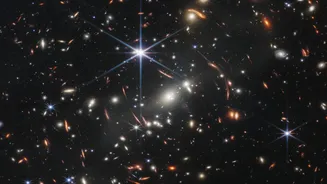
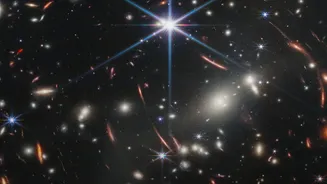
Despite its success, the standard model isn’t perfect. In recent years, new observations have created cracks in this tidy picture. One major issue is the 'Hubble tension', a persistent disagreement in measurements of how fast the universe is expanding today versus how fast we predict it should be expanding based on data from the early universe. It’s like two trusted clocks telling different times. Furthermore, the James Webb Space Telescope (JWST) has discovered surprisingly mature and massive galaxies in the very early universe. These galaxies appear too well-formed to have grown so quickly in the time allowed by the standard 13.8-billion-year timeline, leading some scientists to question if the timeline itself is wrong.
A Radically Older Universe
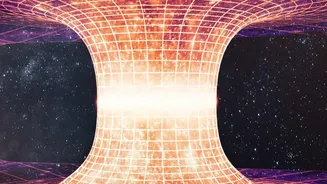
Enter the new study from University of Ottawa researchers Rajendra Gupta and Nikolaos Samaras. They've been testing an alternative model known as CCC+TL (Covarying Coupling Constants plus Tired Light). This model proposes something radical: the universe is actually 26.7 billion years old, nearly twice the age given by the standard model. In this version of cosmic history, there’s no need for dark matter or dark energy. Instead, the model suggests that the fundamental forces of nature and the properties of particles might change over time. It also incorporates the 'tired light' theory, an old idea that light loses energy as it travels across vast cosmic distances, which could be misinterpreted as accelerating expansion.
What the New Research Found
To test their idea, Gupta and Samaras didn't just theorize; they ran the numbers. In a paper published in the Monthly Notices of the Royal Astronomical Society, they showed their CCC+TL model could successfully explain several major cosmic observations. For instance, the model accurately reproduces the rotation of 175 different galaxies without needing to invoke the gravitational pull of dark matter. Crucially, an older universe would give those 'impossible' early galaxies discovered by the JWST billions of additional years to form and mature, making their existence entirely predictable. According to Gupta, their model successfully meets multiple challenges that other alternative theories often fail to explain in a unified way.
A Revolution or Just a Revision?
So, is it time to throw out the textbooks? Not yet. The ΛCDM model has decades of strong evidence behind it, and any challenger faces an uphill battle. Many cosmologists remain skeptical of alternatives that discard dark matter and dark energy, for which there is considerable indirect evidence. However, the persistence of problems like the Hubble tension and the mystery of the early galaxies means that the scientific community is taking new ideas seriously. Science progresses by questioning its own assumptions. Whether this new model ultimately proves correct or not, it forces a deeper look at the data and pushes physicists to refine our understanding of gravity, expansion, and our ultimate origins.