





The New Research Assistant
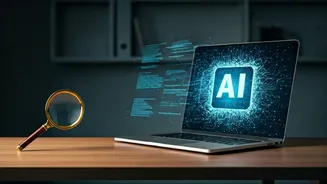
A new class of artificial intelligence is changing how we find information. Known as source-finding or research AI, tools like Perplexity, Scite, and Sourcely are designed to act as powerful research assistants. Unlike a standard search engine that provides
a list of links, these platforms digest your question, scan vast databases of academic papers and web pages, and then synthesize the findings into a concise summary, complete with citations. The goal is to automate the most time-consuming parts of research: literature reviews, data gathering, and summarization. For students, journalists, and professionals, this technology promises to dramatically accelerate the process of discovery, freeing them up to focus on higher-level tasks.
Accelerating Discovery
The primary benefit of these AI tools is speed. A task that once took hours or even days—sifting through dense academic papers or a sea of search results—can now be done in minutes. These systems excel at processing massive datasets, identifying patterns and connections that a human researcher might miss. They can help break down complex topics for non-specialists, making knowledge more accessible. For researchers, AI assistants can handle the repetitive, administrative tasks of research, such as formatting citations or sorting data, allowing more time for creativity, analysis, and generating new ideas. This efficiency can significantly boost productivity and potentially lower the barrier to entry for conducting in-depth research across various fields.
The Dangers of Blind Trust
However, this convenience comes with significant risks. A primary concern is the phenomenon of "AI hallucinations," where the model generates confident, fluent-sounding information that is factually incorrect or entirely fabricated. This can include inventing academic papers, misattributing quotes, or providing false data. Over-reliance on these tools can also lead to what experts call "cognitive offloading," where users delegate their thinking processes to the machine. Studies have shown that this can erode critical thinking, reasoning, and problem-solving skills over time, as the user is no longer engaging in the deep cognitive effort required for true understanding. The AI becomes a black box, and the user risks accepting its output without the necessary skepticism.
Thinking Remains a Human Job
Despite their power, AI tools cannot replicate the core components of human thought. Critical thinking—the ability to evaluate information, question assumptions, form independent judgments, and understand context—remains a uniquely human skill. An AI can find sources, but it cannot determine if a source is truly relevant to the nuanced argument you are trying to build. It can summarize, but it can't have a novel insight. A 2025 study noted that higher user self-confidence is associated with more critical thinking, while higher confidence in the AI is associated with less. The human researcher is still responsible for asking the right questions, interpreting the findings, and weaving them into a coherent and original narrative. As APA publishing guidelines state, to be an author, you must be a human, because a machine has no accountability.
Building a Better Workflow
The most effective approach is to treat source-finding AI not as a replacement, but as a partner. This means developing a new workflow that leverages the AI's strengths while mitigating its weaknesses. Start by using the AI for brainstorming and initial exploration, but always verify its outputs. Best practices include always checking the original sources for AI-generated claims and citations. Use the AI to handle routine tasks, but reserve the critical analysis and final judgment for yourself. Experts recommend maintaining transparency about when and how AI was used in the research process. By actively engaging with the AI's output—questioning it, refining prompts, and cross-checking with other sources—users can avoid the passive consumption that dulls critical faculties and instead use the tool to augment their own intelligence.