







Why Your Shoes Are Holding You Back
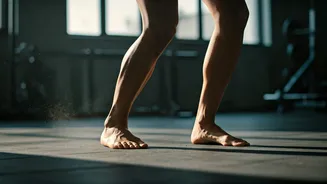
Modern footwear, with its cushioning and rigid support, can act like a cast for your feet. While protective, it dulls the intricate network of nerves on the soles of your feet. These nerves are crucial for proprioception—your body's ability to sense its position
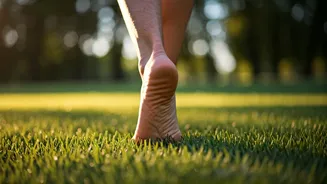
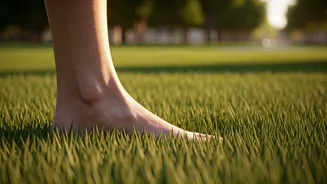
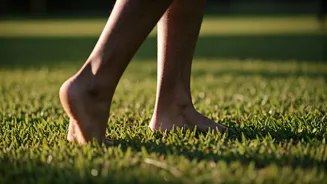
in space. When you go barefoot on a natural surface like grass, you 'wake up' these nerves. Your brain receives a flood of detailed information about the terrain, forcing the small stabilising muscles in your feet and ankles to fire up and engage. This constant micro-adjustment is what builds true, functional strength. It’s not about getting visibly ‘ripped’ in the bodybuilding sense, but about developing resilient, responsive ankles that can handle uneven ground, quick direction changes, and the demands of daily life and sport.
The Foundation of Your Fitness
Think of your ankles as the foundation of a building. If the foundation is weak or unstable, the entire structure above it is compromised. Weak ankles can lead to a cascade of issues, including poor running form, knee pain, hip imbalances, and even lower back problems. By strengthening them directly, you’re not just preventing a sprained ankle; you’re improving your entire kinetic chain. Strong, mobile ankles allow for better force absorption when you land, more powerful push-offs when you jump or run, and superior balance in everything you do. This barefoot work is a small investment of time that pays huge dividends for your overall athletic performance and long-term joint health.
Before You Begin: Safety First
Before you dash to the nearest park and shed your shoes, a few precautions are essential. Start slow. Your feet have been coddled for years and need time to adapt. Begin with just five to ten minutes and gradually increase the duration. Choose your surface wisely. Soft, clean grass is ideal. Avoid concrete, asphalt, or any terrain with sharp objects like broken glass, thorns, or sharp rocks. Always scan the area before you start. Listen to your body. If you feel any sharp pain (different from muscle fatigue), stop immediately. People with certain conditions, like diabetes or peripheral neuropathy, should consult their doctor before starting any barefoot activity, as reduced sensation can increase the risk of injury.
Drill 1: Toe Yoga and Spreading
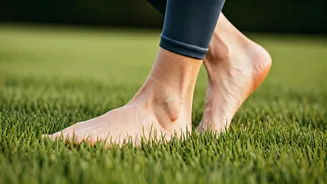
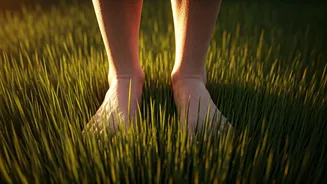
This is ground zero for reawakening your foot muscles. Stand with your feet flat on the grass. Without moving your foot, try to lift just your big toe while keeping the other four toes pressed down. Hold for a few seconds, then lower it. Next, try the opposite: press your big toe down and lift the other four toes. It might feel impossible at first, but it improves with practice. Then, simply try to spread your toes as wide apart as you can, like you’re fanning them out. Hold for 10-15 seconds. These small movements isolate and strengthen the intrinsic foot muscles that support your arch and stabilise your ankle.
Drill 2: Single-Leg Balance
A classic for a reason. Stand on one leg and try to hold your balance for 30 seconds. Being barefoot on grass makes this much more challenging and effective. Your foot will constantly make tiny adjustments to keep you stable. Once you can comfortably hold for 30 seconds, increase the difficulty. Try closing your eyes, which removes visual input and forces your ankles to work even harder. You can also add gentle movement, like slowly swinging your raised leg forward and back, or reaching down to touch the ground in front of you. Perform 3 sets of 30 seconds on each leg.
Drill 3: Barefoot Calf Raises
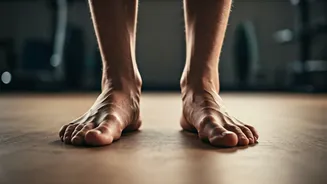
Calf raises are simple, but doing them barefoot changes the game. Stand with your feet hip-width apart. Slowly rise up onto the balls of your feet, going as high as you can. Focus on a controlled, steady movement—no bouncing. Hold at the top for a second, feeling the engagement in your calves and the stabilising work in your ankles. Then, slowly lower yourself back down. The key is the slow, controlled descent. This builds eccentric strength, which is vital for shock absorption and injury prevention. Aim for 3 sets of 15-20 repetitions.