





The Curious Case of a ‘Puffy’ Planet
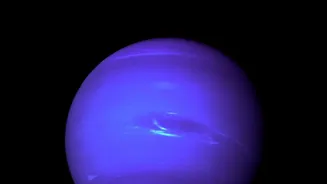
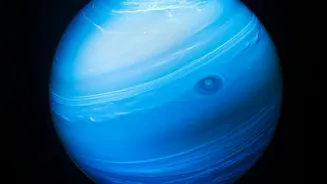
Imagine a planet as large as Jupiter but with less than a tenth of its mass. That gives you some idea of the strange nature of WASP-107 b, an exoplanet that has baffled astronomers. Located over 200 light-years from Earth, it’s often described as a “puffy”
or “cotton-candy” planet due to its extraordinarily low density. It belongs to a class of worlds known as “warm Neptunes”—gas giants similar in size to our own Neptune but orbiting much closer to their host stars. This proximity makes them hot, but not as scorching as the “hot Jupiters” that orbit even closer. For years, the surprisingly low mass of WASP-107 b presented a major puzzle for theories about how planets form. Its strange properties, however, also make it a perfect laboratory for studying the atmospheres of worlds unlike any in our solar system.
A Chemical Signature That Defies Expectation
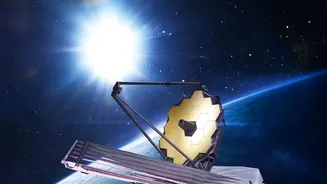
Using the powerful infrared vision of the James Webb Space Telescope (JWST), scientists recently peered into the atmosphere of WASP-107 b. They found the chemical fingerprints of water vapor, carbon dioxide, and even sulfur dioxide. But the most surprising detection was methane. On a planet this warm, methane—a simple molecule of one carbon and four hydrogen atoms—is not expected to survive in the upper atmosphere. The intense heat and stellar radiation should rapidly break it down through chemical reactions. In fact, before the launch of JWST, methane had been strangely absent in observations of many exoplanets where it was theoretically expected, creating a long-standing mystery. Finding it here was a clear signal that something unusual and powerful was happening within the planet's atmosphere.
A Story of Powerful Updrafts
The presence of methane where it shouldn't be provides a crucial clue about the planet’s “atmospheric dynamics”—a term for how its atmosphere churns, flows, and behaves. The leading explanation is that WASP-107 b has incredibly vigorous vertical winds. Think of it as a massive planetary conveyor belt. Methane is likely abundant in the cooler, deeper layers of the planet's atmosphere. Powerful updrafts are dredging this methane-rich gas up to the observable upper layers so quickly that it doesn't have time to be destroyed. This process, known as disequilibrium chemistry, shows that the atmosphere is not a calm, settled layer of gases but a turbulent, dynamic system driven by the planet’s hot interior. The detection of methane, therefore, isn't just about one gas; it's a tracer that reveals the engine of the planet’s weather.
Solving More Than One Puzzle
This new understanding of the atmosphere did more than just explain the methane. By precisely measuring the amounts of different molecules, including methane, scientists were able to build a much more accurate model of the planet as a whole. This allowed them to recalculate the mass of WASP-107 b’s core, which turned out to be significantly heavier than previous estimates had suggested. This new, larger core mass resolves a major tension with leading theories of planet formation, which had struggled to explain how such a low-density planet could have formed. It’s a perfect example of how studying a planet’s atmosphere can unlock fundamental secrets about its interior structure and its origin story, showing just how interconnected all aspects of a planet truly are.
A New Era of Planetary Science
The discovery on WASP-107 b is part of a wave of groundbreaking atmospheric science enabled by the JWST. Similar detections, like the observation of methane on another warm exoplanet, WASP-80 b, confirm that we are entering a new era of exploration. For the first time, we can move beyond simply detecting exoplanets to dissecting their climates, chemistry, and internal processes in remarkable detail. While these gas giants are not candidates for life, the techniques and models being honed here are crucial. They are the dress rehearsal for the ultimate goal: using the same methods to analyze the atmospheres of smaller, rocky, Earth-like worlds for the chemical signs that could, one day, point to life beyond our solar system.