


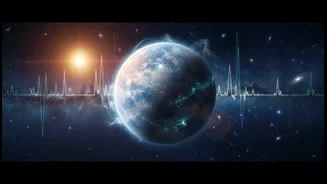



A Glimmer in the Void
Scientists have now confirmed the presence of water vapour in the atmospheres of several exoplanets, which are planets that orbit stars outside our solar system. These discoveries, made by powerful observatories like the James Webb Space Telescope (JWST),
are not just footnotes in an astronomy textbook; they are game-changers. For instance, the JWST has detected water in the atmospheres of gas giants like WASP-96 b, and more excitingly, in the planet-forming disk of a young star system called PDS 70. This suggests that the raw materials for water-rich rocky planets, like Earth, are available from the very beginning of a solar system's life. Even smaller, potentially rocky worlds are coming into focus, with detections around planets like GJ 9827d transforming the search for worlds that might host life.
Reading the Cosmic Fingerprint
So how do scientists find water hundreds of light-years away? The primary method is called transit spectroscopy. When an exoplanet passes in front of its host star from our point of view, a tiny fraction of the starlight filters through the planet's atmosphere. Telescopes like the JWST can analyse this light, spreading it out into a spectrum, much like a prism creates a rainbow. Different molecules in the atmosphere absorb specific colours, or wavelengths, of light, leaving behind a unique 'fingerprint'. Water molecules create a very distinct and recognisable pattern in this spectrum. Before the JWST, such measurements were often difficult, but its advanced instruments can capture these detailed atmospheric profiles, revealing not just water but also other gases like methane and carbon dioxide.
More Than Just a Drink
The excitement around finding water isn't just because it’s familiar. On Earth, liquid water is essential for every form of life we know. It acts as a universal solvent, transporting nutrients and enabling the chemical reactions that drive biology. Finding water vapour in an exoplanet’s atmosphere is the first step to determining if that world could have liquid water on its surface. However, its presence alone isn’t a guarantee of life. A planet like GJ 9827d, for example, is as hot as Venus, meaning any water there would exist as a steamy, inhospitable blanket. The goal is to find a rocky planet in the 'habitable zone'—the orbital range where temperatures are just right for liquid water to exist on the surface. Recent detections of an atmosphere around LHS 1140 b, a rocky world in its star's habitable zone, make it a prime target for these investigations.
A Key Piece of the Puzzle
Water vapour is considered a 'biosignature'—a substance or pattern that could indicate the presence of life. However, it's an ambiguous one because it can also be produced by non-biological processes. Therefore, scientists look for a combination of clues. An ideal candidate for life would be a rocky planet in the habitable zone with an atmosphere containing water vapour, alongside a mix of other gases that are out of chemical balance. On Earth, for example, the simultaneous presence of oxygen and methane is a strong sign of life, as these gases would normally react with and destroy each other over time. Their continued coexistence implies that living organisms are constantly replenishing them. The hunt is on for this specific cocktail of gases on other worlds.
The Next Frontier of Discovery
The detection of water vapour marks a new era in exoplanet research. The focus is shifting from simply finding planets to characterising them in detail. With the JWST and future observatories, scientists will be able to analyse the atmospheres of more Earth-sized, rocky planets. The goal is to build a complete picture of these worlds, measuring their temperature, atmospheric composition, and identifying any potential biosignatures. There are still challenges; sometimes the water signal could be coming from the star itself rather than the planet. And recent studies suggest that water could be hidden deeper inside a planet's interior, meaning atmospheric readings might not tell the whole story. Despite these complexities, each detection sharpens our understanding and refines our search, moving us closer to knowing if any of the thousands of known exoplanets could truly be called 'habitable'.