




Witness the Spectacle of Pulikali in Thrissur
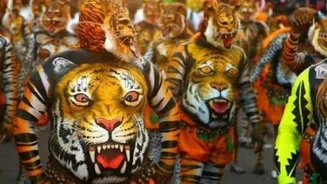
Forget everything you think you know about street parades. On the fourth day of Onam, the streets of Thrissur erupt in a riot of colour and energy with Pulikali, the 'tiger dance'. This 200-year-old folk art form sees hundreds of performers, their bodies
meticulously painted over hours to resemble tigers and leopards, dance to the hypnotic rhythm of traditional percussion instruments like the thakil and udukku. The main event unfolds at Swaraj Round, where troupes from across the district converge to showcase their skills, creating a spectacle that is both visually stunning and deeply rooted in local tradition. It is more than just a dance; it is a fierce, joyful expression of the festival's spirit, introduced by Maharaja Rama Varma Sakthan Thampuran of Cochin. For travellers, it’s a chance to witness an unforgettable cultural phenomenon that draws over a lakh spectators annually.
Feel the Rhythm of the Aranmula Boat Race
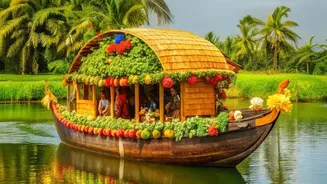
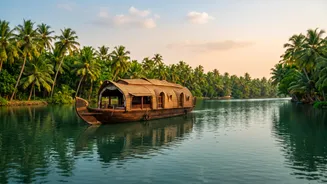
The Vallam Kali, or snake boat race, is a signature Onam event, but the Aranmula Uthrittathi Vallamkali is in a league of its own. More of a ritual than a race, this event on the Pamba River is a sacred offering to Lord Krishna of the Sree Parthasarathy Temple. Legend holds that the race commemorates the protection of a sacred boat carrying offerings for a temple feast. The majestic 'Palliyodams', or snake boats, are treated as divine vessels. Each is over 100 feet long and carries around 100 oarsmen, 25 singers, and several helmsmen. Dressed in traditional white mundus and turbans, the oarsmen row in perfect synchrony while chanting Vanchipattu, or boat songs. The atmosphere is electric, not with competitive rivalry, but with profound devotion and community spirit, offering a glimpse into a tradition that has been alive for centuries.
Savour an Authentic Onam Sadya
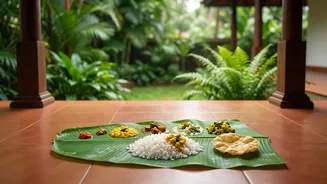
No Onam experience is complete without partaking in the Onam Sadya, a magnificent vegetarian feast that is a culinary masterpiece. Served on a banana leaf, the Sadya can feature over 25 dishes, each with its own specific place on the leaf and a distinct role in the symphony of flavours. From crispy pappadams and banana chips to an array of pickles, thoran (dry vegetable stir-fry with coconut), and pachadi (yoghurt-based curries), the meal is a journey through sweet, sour, salty, and spicy tastes. Key dishes include Avial, a mixed vegetable stew in a coconut and yogurt sauce, and Sambar, a lentil-based vegetable curry. While many restaurants offer Sadya, for a truly authentic experience, consider visiting a local homestay or being invited to a family home. For a massive community feast, the Thrikkakara Vamana Moorthy Temple in Ernakulam, believed to be the epicentre of Onam, serves Sadya to over 20,000 devotees.
Explore the Roots of Onam at Thrikkakara Temple
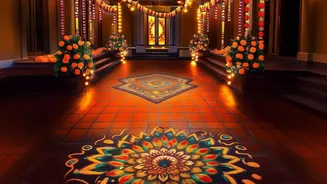
To understand the heart of Onam, a visit to the Thrikkakara Vamana Moorthy Temple in Ernakulam is essential. This ancient temple is considered the origin site of the festival, dedicated to Vamana, the fifth avatar of Vishnu, whose story is intertwined with the legend of King Mahabali that Onam celebrates. The ten-day festival kicks off here with the 'Athachamayam', a grand cultural procession that once marked the journey of the Maharaja of Kochi to the temple. Today, it’s a vibrant parade showcasing a medley of Kerala’s traditional art forms like Kathakali, Mohiniyattam, and Panchavadyam. Visiting the temple during Onam offers a chance to see devotional celebrations, including the creation of intricate Pookalam (floral carpets) and grand processions with caparisoned elephants, especially on the final days of the festival.