




The Invisible Danger of Deep Space
Before we can build settlements on the Moon, we have to solve a life-threatening problem. Unlike Earth, which is protected by a magnetic field and a thick atmosphere, the Moon is constantly bombarded by two types of dangerous radiation. The first comes
from our own sun in the form of 'solar particle events', intense bursts of protons that can erupt with little warning. The second, and more persistent, threat is Galactic Cosmic Rays (GCRs). These are high-energy particles, remnants of distant supernovas, that travel across the galaxy. Long-term exposure to GCRs poses significant health risks to astronauts, including an increased chance of developing cancer. The short Apollo missions of the past gave us a glimpse of this challenge, but for the long-duration stays planned by NASA's Artemis program and other international efforts, a robust solution is not just an option—it is essential for survival.
Why We Can't Just Pack a Shield
The most straightforward solution would be to launch habitats with thick shielding made from materials like lead, water, or dense plastics. However, the economics of space travel make this nearly impossible. Every kilogram launched into space costs an immense amount of money. The sheer weight of the required shielding material would make any mission to establish a permanent base prohibitively expensive. This 'tyranny of the rocket equation' has forced space agencies and private companies to think outside the box, or in this case, outside the planet. The most logical and cost-effective answer is to build with what's already there. This strategy, known as In-Situ Resource Utilization (ISRU), is the cornerstone of modern plans for lunar colonization.
Lunar Soil: The Ultimate Building Material
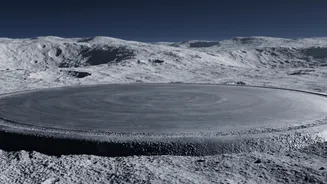
The Moon's surface is covered in a fine, grey powder called regolith. This 'lunar soil' is the result of billions of years of meteorite impacts pulverizing the rock below. While its abrasive, glass-like nature presents engineering challenges, regolith is also the key to our radiation problem. Studies by the European Space Agency (ESA) and other institutions have confirmed that a thick layer of compacted lunar regolith—somewhere between one and two meters—can provide significant protection from both solar particles and GCRs. The soil itself acts as a massive physical barrier, absorbing and scattering the incoming radiation particles before they can reach the astronauts inside a habitat. Using regolith means future lunar settlers won't have to import their most critical safety feature; they can simply harvest it on-site.
Robots: The Construction Crew of the Future
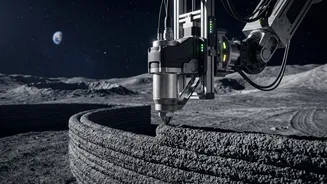
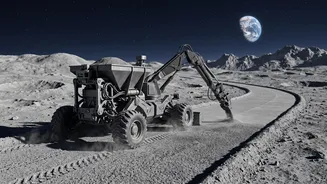
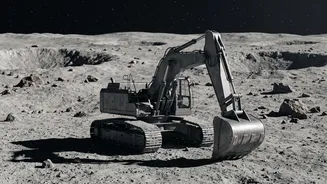
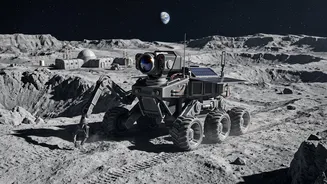
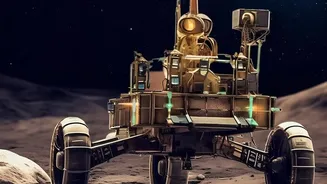
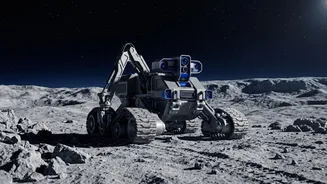
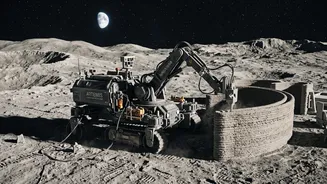
So, we have our building material. But how do we build with it? Sending human construction crews to spend months assembling habitats in bulky spacesuits is inefficient and dangerous. The solution is to send the robots first. Companies like ICON and GITAI, along with major space agencies, are developing fleets of autonomous and semi-autonomous robots designed specifically for lunar construction. These machines will be the surveyors, excavators, and builders of the first moon bases. Using techniques like laser sintering or microwave-powered 3D printing, these robotic systems will be able to melt the regolith and extrude it layer by layer, forming solid, interlocking blocks or even entire domed structures. This process, sometimes called additive manufacturing, allows for the creation of complex and durable habitats without direct human labour on the hazardous surface.
From Earthly Tests to a Lunar Reality
These concepts are rapidly moving from theory to practice. On Earth, researchers are using simulated lunar soil to test different 3D printing methods and structural designs, like the hollow, cellular domes proposed by architectural firm Foster + Partners in collaboration with ESA. These tests help refine the technology, from the robotic arms that will do the building to the methods for fusing the abrasive dust into a solid ceramic-like material. There are still hurdles to overcome, such as ensuring the robots can operate in the extreme lunar temperatures and dealing with the communications delay between Earth and the Moon. However, projects like China's Chang'e 8 mission, which aims to test 3D printing on the Moon around 2028, show a clear roadmap. Small, specialized robotic missions will likely come first, proving each capability before a full-scale construction effort begins.