
A Planet's Breath
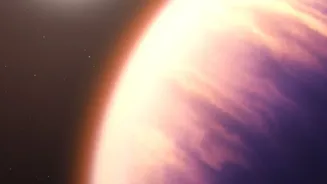
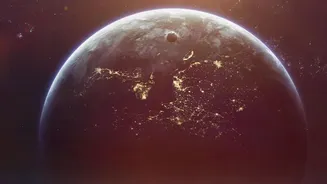
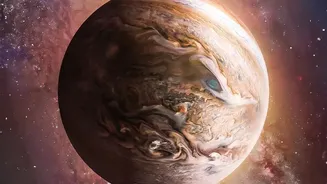
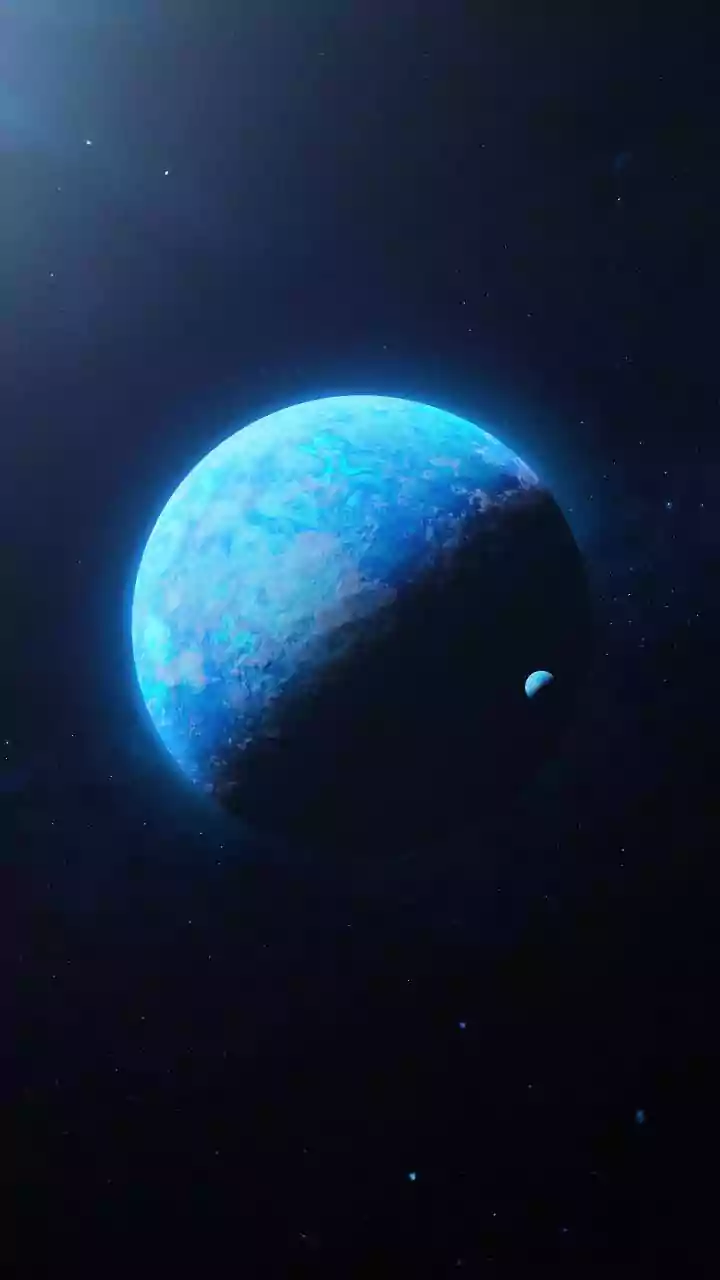
Think of a planet's atmosphere as its breath. Just as our breath can reveal details about our health and what we have been eating, a planet's atmosphere holds vital clues about its internal processes. For astrobiologists, this gaseous envelope is far
more revealing than a simple photograph. While a planet's size or its distance from a star can tell us if it's in the habitable zone—the region where liquid water could exist on the surface—the atmosphere tells a much richer story. It reveals the planet’s chemistry, its climate, and whether it has the building blocks necessary to support life. It's the difference between seeing a house from the outside and being able to analyse a sample of the air inside for signs of occupancy.
Decoding an Alien Sky with Light
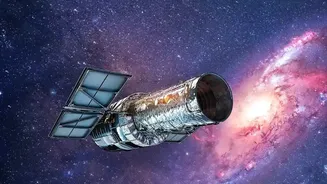
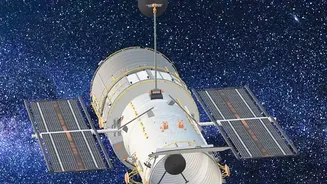
Scientists can't just scoop up a sample of air from a planet hundreds of light-years away. Instead, they use a clever technique called transit spectroscopy. When an exoplanet passes in front of its host star from our point of view, a tiny amount of starlight filters through the planet's atmosphere. Instruments on telescopes like the James Webb Space Telescope (JWST) can capture this light and split it into a spectrum, which looks like a rainbow barcode. Different gases in the atmosphere absorb specific colours or wavelengths of light, leaving dark lines in that barcode. Each chemical—like water vapour, methane, or carbon dioxide—has a unique spectral fingerprint, allowing scientists to identify the ingredients of an alien atmosphere from across the galaxy.
The Search for Biosignatures
The ultimate goal is to find what scientists call biosignatures: gases or combinations of gases that are likely produced by living organisms. On Earth, life produces a host of gases, but the most prominent detectable ones are oxygen, ozone (a byproduct of oxygen), and methane. Finding any one of these alone isn't proof of life. Methane, for instance, can be produced by volcanoes. Oxygen can be created through non-biological chemical reactions. The key is to find a specific mix of gases that shouldn't exist together in large quantities without a constant source replenishing them—a source like life. The simultaneous presence of oxygen and methane, for example, is a strong potential biosignature because they would normally react and destroy each other. Finding them together suggests something is actively producing both.
Ruling Out Cosmic Impostors
Detecting a promising gas is just the first step. The real challenge is confirming it wasn't produced by something other than life. This involves ruling out 'false positives'. For instance, a planet's geology, its star's radiation, or photochemical reactions in the atmosphere can all create gases that might mimic signs of life. Scientists at a CIRES-led lab recently showed that dimethyl sulfide (DMS), a gas on Earth produced almost exclusively by marine life, could potentially be formed without life in certain atmospheric conditions. This is why context is critical. Astronomers use complex models to understand the planet's entire system—its star, its geology, its chemistry—to determine if a biological explanation is the most plausible one for the gases they detect. The discovery isn't a single 'eureka' moment, but a painstaking process of elimination.
The Next Generation of Discovery
The technological leap represented by the James Webb Space Telescope has revolutionised this field. Its ability to analyse infrared light allows it to pick up the chemical fingerprints of smaller, rocky worlds with unprecedented detail. Already, JWST has provided stunning insights into the atmospheres of gas giants and has begun to probe the air of potentially habitable planets like those in the TRAPPIST-1 system. For example, possible detections of biosignatures like dimethyl sulfide on the planet K2-18b have generated excitement, though researchers are still cautiously working to confirm the findings. These early results show that finding definitive proof of life is incredibly complex, but the technology to systematically search for it is finally here. This endeavour is pushing the boundaries of what's possible in robotics, optics, and data analysis.