
The Clockwork Universe and Its Flaws
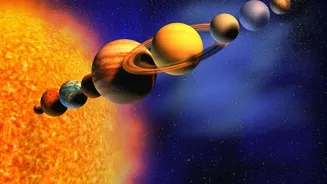
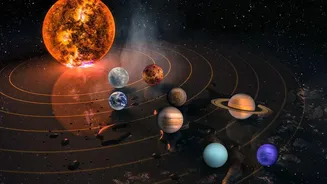
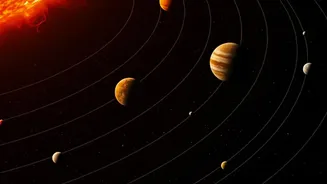
Since the days of Isaac Newton, we have understood that gravity governs the motions of the planets. For centuries, this led to a picture of a predictable, clockwork solar system. If you knew the positions and velocities of the planets now, you could,
in theory, calculate their positions at any point in the future. For short timescales, like a few thousand years, this model works beautifully. We can predict eclipses and transits with incredible accuracy. However, a major complication arises when you add more bodies to the system. The 'two-body problem' (like the Earth and Sun) is solvable. But the 'n-body problem', which describes our solar system with its eight planets and countless smaller objects, has no exact, clean solution. Each body pulls on every other body, creating a web of complex interactions that makes perfect long-term prediction impossible.
Welcome to a Chaotic System
This is where chaos theory comes in. In physics, 'chaos' does not mean random disorder. It describes systems where tiny, almost immeasurable differences in the starting conditions can lead to vastly different outcomes over time. Think of it as a cosmic butterfly effect: an error of just millimetres in measuring Mercury's position today could mean we have no idea where it will be in its orbit 200 million years from now. Our solar system is a chaotic system. The primary source of this chaos comes from 'resonances', where the orbital periods of two planets align in a simple ratio, allowing small gravitational nudges to add up and significantly alter an orbit. Over billions of years, these accumulated nudges can stretch or tilt a planet's orbit in unpredictable ways.
Why One Simulation Is Not Enough
Because of this extreme sensitivity to initial conditions, running a single simulation of the solar system's future is not just difficult, it's pointless. That one simulation would represent only one of an almost infinite number of possible futures. Scientists can't know the exact position and velocity of every planet down to the last centimetre, so they do the next best thing: they run hundreds, sometimes thousands, of simulations. Each simulation starts with slightly different parameters, all within the range of our current measurement uncertainties. By creating this 'ensemble' of possible futures, researchers can map out the probabilities of different outcomes. They are not asking 'What will happen?' but rather 'What are all the things that could happen, and how likely are they?'.
The Cosmic Lottery of Planetary Fates
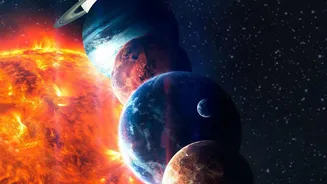
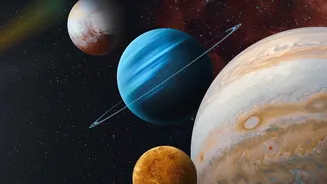
These simulations have revealed a range of fascinating, if distant, possibilities. The vast majority of simulations show the solar system remaining broadly stable for billions of years, with the planets staying in orbits very similar to their current ones. However, in a small percentage of cases, things get dramatic. Some simulations show Mercury's orbit becoming highly eccentric, creating a small chance it could collide with Venus or even be flung into the Sun. More recent studies have focused on the end of the Sun's life, about five billion years from now. As it expands and then shrinks into a white dwarf, the Sun will lose mass not smoothly, but in violent, uneven bursts. Hundreds of simulations show these 'kicks' could destabilize the outer planets, with some scenarios showing Saturn being ejected from the solar system entirely or Uranus and Neptune swapping places.
Should We Worry About Earth?
The short answer is no. Our planet's orbit is considered stable for the foreseeable future. The dramatic events seen in these simulations are extremely low-probability and are set on timescales of billions of years. By the time any of these chaotic instabilities could potentially threaten Earth, our planet will have far bigger problems. In about five billion years, the Sun will expand into a red giant, boiling away our oceans and likely engulfing the planet entirely. The stability studies are not about immediate danger; they are about understanding the fundamental nature of gravity and the intricate dance of the planets over cosmic timescales.