


A Cosmic Seismograph
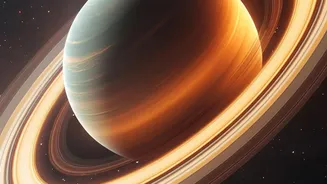
One of the most groundbreaking discoveries is that Saturn's rings act like a giant seismograph, recording the planet's inner turmoil. Just as earthquakes create seismic waves on Earth, Saturn's interior constantly oscillates and pulsates. These subtle
movements cause gentle ripples in the planet's gravitational field, which in turn create visible waves in the rings. By studying these waves, captured in stunning detail by NASA's Cassini spacecraft, scientists can peer deep inside the gas giant. This technique, called 'kronoseismology', has led to a startling revelation about Saturn's core. Instead of a solid, compact ball of rock, Saturn appears to have a massive, 'fuzzy' core that is a diffuse soup of ice, rock, and metallic fluids. This enormous core is estimated to span up to 60% of the planet's diameter, a much larger and more complex structure than theories had previously suggested.
A Debate on Age
For decades, scientists debated whether the rings were as old as Saturn itself—about 4.5 billion years—or a much more recent addition. Data gathered by the Cassini mission, which orbited Saturn from 2004 to 2017, provided strong evidence for the latter. By analyzing the rate at which interplanetary dust has accumulated on the pristine ice of the rings, researchers concluded they are surprisingly young. The prevailing theory for years was that the rings are likely no more than 100 to 400 million years old, meaning they might have formed when dinosaurs still roamed the Earth. This suggests they are a temporary phenomenon. However, more recent research from late 2024 has challenged this, proposing that the rings could be as old as the planet. This newer computer modeling suggests that when micrometeoroids hit the rings, they vaporize and the debris is drawn toward Saturn or out into space, effectively keeping the rings clean and making them appear younger than they are. This ongoing scientific debate highlights just how much we are still learning.
A Persistent, Polluting Rain
The rings are not a closed system; they are actively interacting with the planet. Scientists have confirmed the existence of 'ring rain', a phenomenon where particles from the rings are constantly being pulled into Saturn's upper atmosphere by gravity and its magnetic field. This influx of material, which includes charged water particles, methane, and other organic molecules, has a significant impact. It heats the planet's upper atmosphere and alters its chemical composition. Observations have shown that this rain 'quenches' parts of Saturn's ionosphere, reducing electron densities in vast regions and explaining long-observed atmospheric anomalies. Data from Cassini's final orbits revealed this rain is more intense than expected, suggesting the rings are disappearing at a rapid rate and may only have another 100 million years or so of existence.
Clues to a Violent Origin
The youthful appearance of the rings, combined with their composition of almost pure water ice, points toward a dramatic origin story. Rather than forming alongside Saturn from the initial solar nebula, it is more likely they are the debris from a cataclysmic event. One leading theory is that an icy moon, perhaps the size of Saturn's moon Mimas, strayed too close to the planet. Saturn's immense gravitational forces would have ripped it apart, and its shattered icy remains would have spread out to form the rings we see today. Another possibility is the destruction of a comet that was captured by Saturn's gravity. Whatever the cause, the rings are a vivid reminder that the solar system has been a dynamic and sometimes violent place, with its history written in the celestial features we can now study in detail.