
The Sun’s 11-Year Heartbeat
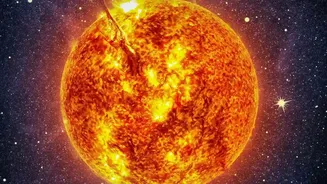
The sun isn't a static ball of fire; it has a rhythmic life of its own. Roughly every 11 years, it goes through a period of intense activity known as the solar maximum. This is the peak of its natural cycle, characterized by a surge in sunspots, which
are dark, cooler areas on the sun's surface with extremely powerful and complex magnetic fields. It’s from these volatile regions that the sun unleashes its most dramatic events: solar flares and coronal mass ejections (CMEs). A solar flare is a tremendous explosion of radiation, while a CME is a colossal eruption of magnetised plasma and particles hurled into space. We are currently in Solar Cycle 25, which began in December 2019 and is proving to be more active than originally predicted, reaching its peak activity phase.
A Celestial Light Show: The Birth of Auroras
When a CME or a strong solar wind travels from the sun, it carries a stream of highly energetic charged particles. After a journey that can take a couple of days, this solar storm collides with Earth’s magnetosphere—the protective magnetic bubble that shields our planet. While most particles are deflected, some are captured and funnelled along Earth’s magnetic field lines toward the North and South Poles. As these particles plunge into our upper atmosphere, they collide with atoms of oxygen and nitrogen. This collision excites the atoms, and as they calm down, they release this excess energy in the form of light. The result is the breathtaking spectacle of the aurora borealis (Northern Lights) and aurora australis (Southern Lights). The different colours are produced by collisions with different gases at various altitudes; oxygen typically glows green and red, while nitrogen produces shades of blue and purple.
The Dark Side: Wreaking Havoc on Satellites
The same solar energy that creates beautiful auroras poses a significant danger to our orbital infrastructure. Satellites, which operate outside the full protection of Earth's atmosphere, are highly vulnerable. The disruption happens in several ways. Firstly, intense solar activity heats and expands the upper atmosphere. This increases atmospheric drag on satellites in low-Earth orbit, slowing them down and potentially causing them to fall out of their intended orbit, as happened to a batch of Starlink satellites in 2022. Secondly, high-energy particles can bombard a satellite's electronics, causing what are known as single-event upsets—flipping a digital 0 to a 1, or vice-versa—which can corrupt data or trigger phantom commands. Over time, this radiation degrades solar panels and critical components, shortening a satellite's lifespan.
Signal Lost: The Impact on GPS and Communications
Solar maximum’s effects are also felt in the signals we rely on every day. Solar flares release powerful bursts of X-ray radiation that travel at the speed of light, reaching Earth in about eight minutes. This radiation can disturb the ionosphere, the atmospheric layer that radio signals bounce off of, causing high-frequency radio blackouts that affect aviation and maritime communications. The charged particles from CMEs and solar flares also disrupt GPS signals as they travel from satellites to receivers on the ground. This can degrade accuracy from a few metres to a complete loss of signal, impacting everything from personal navigation in your car to precision agriculture and global shipping logistics.