

Our Standard Cosmic Story
For decades, astronomers have worked with a well-established timeline of the universe. It begins with the Big Bang around 13.8 billion years ago, followed by a period of darkness. Then, over hundreds of millions of years, gravity slowly coaxed sparse
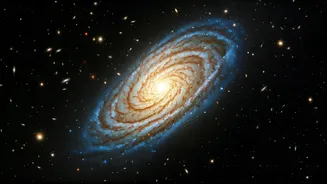
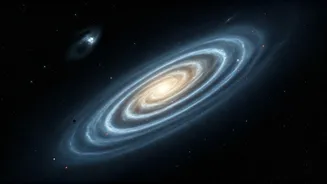
clouds of hydrogen and helium to clump together. This process, known as hierarchical formation, is a cornerstone of the standard model of cosmology, called Lambda-CDM. It predicts a gradual, bottom-up construction of the cosmos: tiny proto-galaxies form first, which then merge over billions of years to create larger, more complex structures like our own Milky Way. According to this model, the early universe should be populated by small, young, and relatively simple galaxies.
A Telescope Rewrites the Rules
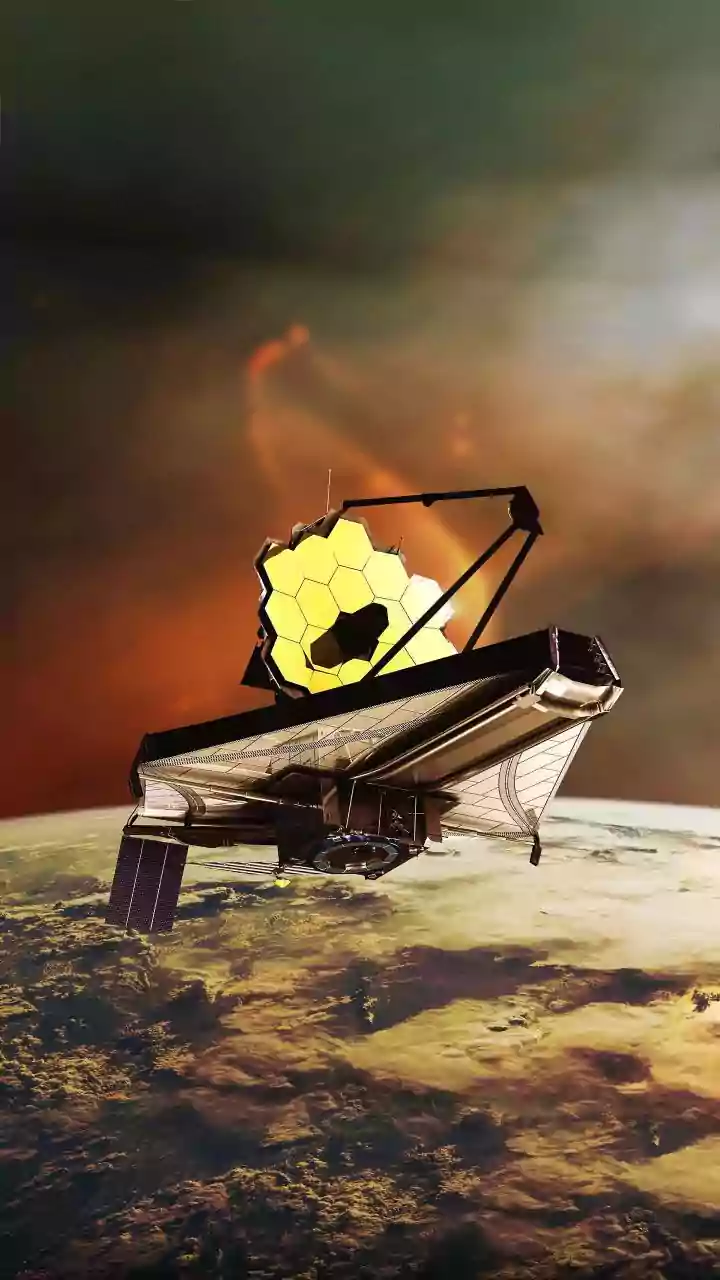
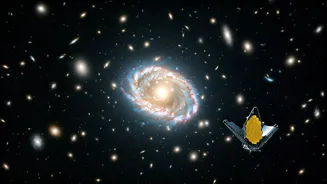
Enter the James Webb Space Telescope (JWST). With its unparalleled ability to peer deep into space—and therefore, far back in time—it was designed to see the universe's first light. And it has delivered, but with a shocking twist. Instead of finding the galactic nurseries full of tiny, fledgling star systems, astronomers are finding what some have called "universe breakers." These are galaxies that existed just 500 to 700 million years after the Big Bang, yet appear bafflingly massive and well-formed. They are packed with stars, have complex structures, and show chemical signatures of maturity that, according to our old models, should have taken billions more years to develop.
The Problem with Precocious Galaxies
The existence of these surprisingly mature galaxies presents a major conundrum. The standard Lambda-CDM model simply does not allow for enough time for such large structures to form. It's like finding a fully-grown adult in a delivery room. The amount of matter (stars and gas) detected in these early galaxies is far greater than what cosmological simulations predict could have accumulated so quickly. Some of these objects appear to contain nearly as many stars as the modern-day Milky Way, forcing scientists to question fundamental assumptions. Either the process of converting gas into stars was dramatically more efficient in the early universe than we thought, or the very ingredients of our cosmological model are missing something crucial.
New Theories for a New Universe
This discrepancy has sent a jolt of excitement and confusion through the scientific community. Researchers are now scrambling to figure out what these findings mean. Some theories propose that the first stars were much larger and burned brighter than previously assumed, making their host galaxies appear more massive than they truly are. Others suggest that some of what we are seeing aren't just galaxies, but supermassive black holes at their centres—known as quasars—that are so luminous they outshine their entire galaxy, creating an illusion of size. More recent analysis of these 'little red dots' suggests they could be a new class of object entirely, dubbed 'black hole stars', where a black hole is cloaked in a dense shell of gas that mimics a star. Still others are exploring more radical ideas, including modifying our understanding of gravity or the nature of dark matter itself.